

A bidet return on investment calculator is only useful when its inputs reflect your household’s real habits and costs. If your family uses less toilet paper than expected, or the bidet costs more to buy and operate, the payback estimate will change. Rather than relying on generic savings claims, start with what you actually spend and the product you’re considering.
To estimate payback fairly, count more than the purchase price. Installation, added water or electricity use, and ongoing upkeep can affect the result. A bidet seat and an integrated bidet toilet also have different costs and installation considerations, so compare each option using its own details.
This guide shows how to build an editable estimate, test different scenarios, and avoid assuming guaranteed savings. You’ll see which costs to include, how to compare product categories, and why comfort and convenience may matter alongside financial payback. The aim isn’t to promise that every bidet pays for itself. It’s to help you decide what makes sense for your home, priorities, and budget.
Key Takeaways
- Use a bidet return on investment calculator as an estimate based on your household’s spending and usage, not as a guaranteed savings forecast.
- Estimate net annual savings by subtracting added operating and upkeep costs from the toilet-paper spending you expect to avoid.
- Compare conservative, expected, and optimistic scenarios, keeping upfront costs, avoided paper spending, and ongoing costs visible.
- Check receipts, utility rates, and product information so your assumptions reflect current costs.
- Weigh comfort, accessibility, features, and toilet fit alongside payback when comparing bidet seats, bidet toilets, and bidet toilet combinations.
What a Bidet Return on Investment Calculator Can, and Cannot, Tell You
A bidet return on investment calculator compares the initial cost of a bidet setup with its estimated net costs or savings over a period you choose. It can help you assess whether reduced toilet-paper spending might offset the purchase, installation, and ongoing expenses. The result is an estimate, not a promise. It depends on the figures you enter and whether your household uses the bidet as expected.
Some parts of the calculation are easy to document, such as the product price or your electricity rate. Other benefits, including comfort, convenience, and ease of personal hygiene, may matter to you but are harder to express in dollars. A broad overview of the Bidet can help first-time readers understand the different forms these fixtures can take. For an ROI estimate, focus on the specific product and household you’re evaluating.
Use the calculator to compare plausible scenarios and identify which assumptions have the biggest effect. It can’t guarantee savings or predict a dependable payback date. Change an input, and the result changes too.
Which bidet-related costs belong in an ROI estimate?
Start with costs you can verify: the product’s purchase price and any installation expense you expect to pay. Depending on the product, include water, electricity, and maintenance costs where relevant. Use product information and current utility rates rather than a generic allowance. If a cost doesn’t apply to the setup you’re considering, leave it out.
Estimate toilet-paper savings just as carefully. Count only the spending your household reasonably expects to avoid. If you’ll still use paper for drying or other needs, don’t treat your entire current toilet-paper budget as a saving.
Why household results differ
Household size and current paper use affect how much spending might be avoided. A household that buys little toilet paper has less spending available to offset other costs than one that buys more. The result can also vary with product features and how often household members use them, where those features affect water or electricity consumption.
For example, two households considering the same product may reach different estimates because they have different utility rates, usage patterns, and paper habits. Treat each result as specific to the inputs, not as a typical outcome or forecast for other households.
How to Calculate Bidet ROI: Inputs, Formulas, and Payback
A useful bidet return on investment calculator makes its assumptions visible. Treat the result as editable: change the expected reduction in paper use, utility costs, or product choice, and the outcome changes. Before calculating, choose a time period and gather current figures rather than relying on generic savings estimates.
Start with the selected product’s verified purchase cost and any installation expense that applies. Estimate how much of your current toilet-paper spending you expect to avoid. Add relevant water, electricity, and maintenance costs using your utility rates and product information. Keep environmental considerations separate from dollar calculations. This discussion of the environmental benefits of bidets offers additional context, but those benefits aren’t automatically household cash savings.
Build a bidet ROI calculator with household-specific inputs
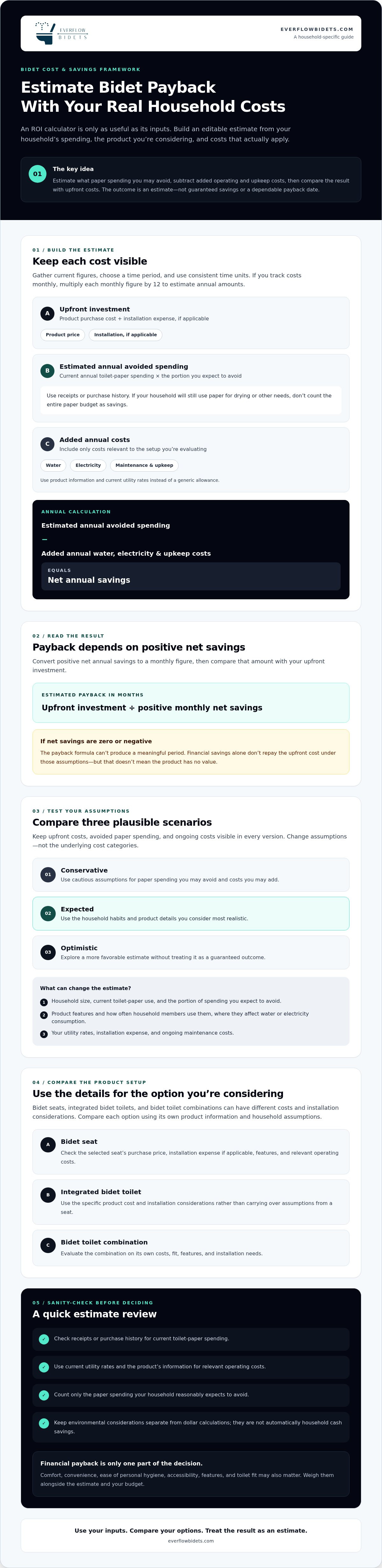
Use consistent time units. For example, calculate annual paper spending and annual operating costs, then compare those annual amounts. If you track spending monthly, multiply each monthly figure by 12 to get an annual estimate.
- Upfront investment: product purchase cost + installation expense, if applicable.
- Estimated annual avoided spending: current annual toilet-paper spending × the portion you expect to avoid.
- Net annual savings: estimated annual avoided spending − added annual water, electricity, and upkeep costs.
Use receipts or purchase history to establish your current paper spending. Then estimate a realistic reduction rather than assuming the entire expense will disappear.
Read payback and ROI results with care
To estimate payback, convert positive net annual savings to a monthly figure, then divide the upfront investment by that amount:
Estimated payback in months = upfront investment ÷ positive monthly net savings.
If net savings are zero or negative, this formula can’t produce a meaningful payback period. That doesn’t mean the product has no value. It means estimated financial savings alone don’t repay the upfront cost under those assumptions.
For simple ROI over a chosen period, calculate cumulative net savings for that period, subtract the upfront investment, then divide by the upfront investment and multiply by 100. Label the period clearly and show the formulas beside the results so you can check each input. Bidet ROI depends on household inputs, so treat every result as specific to the assumptions you entered.
Once you’ve set your assumptions, compare product categories such as bidet toilet seats and assess which option fits your estimate and priorities.
Compare Bidet ROI Scenarios Without Assuming Guaranteed Savings
A single estimate can hide how much the result depends on your assumptions. Use a bidet return on investment calculator to compare conservative, expected, and optimistic scenarios. Adjust expected paper use and operating costs while keeping product-specific expenses visible. These are planning cases, not predictions. Enter your own figures in each row rather than treating any scenario as typical.
| Scenario | Upfront cost | Estimated annual paper spending avoided | Estimated annual ongoing costs | Estimated net annual savings |
|---|---|---|---|---|
| Conservative | Product + installation: [enter your estimate] | [enter a lower expected reduction] | Water + electricity + upkeep: [enter your estimate] | Avoided spending minus ongoing costs |
| Expected | Product + installation: [enter your estimate] | [enter your most reasonable estimate] | Water + electricity + upkeep: [enter your estimate] | Avoided spending minus ongoing costs |
| Optimistic | Product + installation: [enter your estimate] | [enter a higher plausible reduction] | Water + electricity + upkeep: [enter your estimate] | Avoided spending minus ongoing costs |
Use the same calculation period in all three cases. If paper use falls less than expected, or water, electricity, and maintenance cost more, estimated net savings shrink and payback may take longer. If net savings are zero or negative, don’t assign that scenario a payback date.
Which assumptions have the greatest effect on estimated ROI?
Test your current paper spending and the portion you realistically expect to avoid. Then vary ongoing costs instead of assuming they’re negligible. Use verified purchase and installation costs for each option. Even a small change to an assumption can shift the result, so make the differences between scenarios explicit.
Financial estimates aren’t the only way to assess an upgrade. For context on toilet-paper production impacts, see Mongabay’s report on why it can be environmentally impactful. Consider that perspective separately from household cash savings.
Bidet seat versus integrated bidet toilet in the calculator
Compare a seat with an integrated option using each product’s own purchase, installation, operating, and upkeep inputs. Neither category automatically delivers better ROI. Household use and actual costs determine the estimate. Browse bidet toilet seats and bidet toilet combinations to research the categories, then enter verified details for the options you’re considering.
How to Personalize and Sanity-Check Your Bidet ROI Estimate
A bidet return on investment calculator is only as reliable as the information entered. Before relying on a payback result, build a baseline from household records and check how much the outcome changes when assumptions shift. This helps separate documented costs from estimates.
Gather reliable household inputs
Collect verifiable figures first. Review recent receipts or purchase records to estimate toilet-paper spending, and use current utility bills for water and electricity rates. Check product documentation for relevant operating and upkeep information. Record installation costs separately from the product price so you can see each part of the upfront investment.
- Paper baseline: Use your household’s spending records, not a general estimate.
- Utilities: Check current rates and product information for any relevant water or electricity use.
- Other expenses: Keep product purchase, installation, and anticipated maintenance as separate entries.
If you can’t verify a figure, label it as an estimate rather than presenting it as a known cost. That makes uncertainty visible and easier to revisit when better information is available.
Run a sensitivity check before relying on payback
Change one input at a time. First, test a lower and higher expected reduction in toilet-paper spending while leaving the other figures unchanged. Then restore your central estimate and increase ongoing costs to see whether the payback result remains plausible. If several assumptions change at once, it’s harder to tell what drove the difference.
Keep the same time horizon and units in every version, such as comparing annual costs with annual savings. If product operating information or upkeep estimates are missing, note that limitation instead of filling the gap with an unsupported number. Recheck utility rates and product details if your records are old or you’re comparing a different bidet option.
A bidet ROI estimate is a planning tool based on your inputs, not a guarantee of savings or a promised payback date. If a small adjustment sharply changes the result, interpret it cautiously. A result that stays similar across reasonable assumptions may be more useful for comparing options, but it still isn’t a guarantee.
After checking your assumptions, explore bidet options for your home and use current product information to refine the estimate.
Choose a Bidet That Fits Your ROI Estimate and Daily Needs
A favorable estimate is useful, but it shouldn’t make the decision for you. A bidet return on investment calculator addresses estimated costs and savings, not how well a product suits your household. A longer payback period doesn’t automatically make a bidet the wrong choice if its usability, comfort, or features better fit your needs.
Use ROI as one decision factor, not the only one
Consider who will use the bidet and what matters in daily use. Think about comfort, ease of operation, accessibility needs, desired features, and fit with your existing bathroom and toilet. A bidet seat upgrades an existing toilet, while an integrated option may be relevant if you’re considering a broader fixture change. Check product details and compatibility information before comparing the full upfront cost.
Keep financial and personal considerations distinct. Don’t assign a dollar value to comfort or health outcomes just to make the ROI look stronger. If you’re considering a bidet to address a medical concern, speak with a qualified healthcare professional for advice specific to your situation.
Take the next step after calculating
Use your estimate to narrow the options, not to force a purchase. Shortlist product categories that fit your household’s priorities and verified budget. Then confirm current product details and costs, along with any installation requirements that may affect your calculation. If you’re considering an upgrade to an existing toilet, bidet toilet seats are one category to compare.
For broader selection, fit, and feature considerations, review product documentation and compare options relevant to your bathroom. Revisit your estimate if the product or installation assumptions change. You can also explore bidet toilet options when you’re ready, without assuming any particular product will deliver a specific financial return.
Use Your Estimate to Choose the Right Next Step
A bidet return on investment calculator helps you assess a product using your household’s spending, expected usage, and ongoing costs. The result is an estimate, not a promise of savings or a guaranteed payback date. Compare scenarios using current records, then weigh the financial picture alongside fit, comfort, accessibility, and the features your household values.
A longer payback doesn’t automatically make a bidet unsuitable. Bidet seats, bidet-toilet combinations, and bidet toilets offer different options to research, and the right fit depends on more than the calculation alone. EverFlow Bidets also provides learning resources to support product research, so you can check relevant details before making a decision.
When you’re ready, explore bidet options and compare what fits your household. Browse EverFlow Bidets’ bidet seats, bidet toilet combinations, and bidet toilets, and choose based on your needs and budget.
Frequently Asked Questions
How do you calculate the return on investment for a bidet?
Calculate estimated net savings first, then compare them with the upfront investment. Subtract added annual operating and upkeep costs from the toilet-paper spending you expect to avoid. For a chosen period, simple ROI is (cumulative net savings minus upfront investment) divided by upfront investment, multiplied by 100. A bidet return on investment calculator should show its inputs and time period so you can check the result.
Can a bidet pay for itself?
Yes, a bidet may pay for itself if the household’s accumulated savings exceed its purchase, installation, and ongoing costs. Whether that happens depends on current toilet-paper spending, expected changes in use, product choice, and operating expenses. If estimated net savings are small or negative, the financial calculation may not show payback. Comfort, accessibility, and convenience may also matter, but they shouldn’t be presented as guaranteed monetary savings.
What costs should a bidet ROI calculator include?
Include the product’s actual purchase cost and any installation expense you expect to pay. Add relevant water, electricity, and maintenance costs based on the product and your household’s records. For potential savings, use current toilet-paper spending and estimate only the portion you expect to avoid. Keep upfront expenses separate from recurring ones, and don’t add costs or savings that don’t apply to the option you’re evaluating.
Does a bidet reduce toilet-paper use enough to affect ROI?
It can affect the estimate, but the amount varies with household habits and how each person uses the bidet. Don’t assume toilet-paper spending disappears. Some households may continue using paper for drying or other needs. Start with your own recent spending, then estimate a realistic reduction and test lower and higher possibilities. That range shows how sensitive the result is to paper-use assumptions without treating any outcome as typical.
Is a bidet seat or bidet toilet a better investment?
Neither category is automatically the better investment. A bidet seat may suit someone upgrading an existing toilet, while a bidet toilet or combination may fit a broader bathroom change. Compare specific options using their verified purchase, installation, operating, and upkeep costs. Also consider toilet compatibility, household preferences, accessibility, and desired features. The best fit depends on your priorities and actual inputs, not the category alone.
How long does it take for a bidet to pay for itself?
Estimate payback by dividing the upfront investment by positive monthly net savings. Convert annual net savings to a monthly figure first, using the same cost assumptions throughout. If estimated net savings are zero or negative, a financial payback period can’t be calculated meaningfully. Any result is an estimate, not a promised date, and it can change if household use, utility costs, or upkeep differs from what you entered.
Should I include water and electricity costs in the calculation?
Include water or electricity costs when they apply to the product you’re evaluating. Check product documentation for relevant usage information, then use your current utility rates to estimate the household expense. If a cost doesn’t apply, leave it out rather than adding a generic allowance. Separating each operating cost makes the calculation easier to audit and helps you compare products using consistent assumptions.
Disclaimer
The information provided in the EverFlowBidets blog is for general informational and educational purposes only. While we strive to publish accurate, current, and well-researched content, nothing on this website should be considered medical advice, diagnosis, or treatment. Articles discussing the potential health, hygiene, accessibility, or environmental benefits of bidet use are based on publicly available research, manufacturer information, and other reputable sources. Individual results may vary, and any health-related decisions should be made in consultation with a qualified healthcare professional.