

What if a comfort height toilet feels easier for one person and awkward for another? The label may sound like a universal upgrade, but comfort depends on who uses the bathroom and how the finished seat height feels in daily use. Standard toilets typically have a seat height of 15 to 16 inches, while comfort-height models generally measure 17 to 19 inches from the floor to the top of the seat.
It’s reasonable to wonder whether a taller toilet will suit everyone at home, or whether “comfort height” means the toilet meets accessibility standards. The terms can overlap in height, but the label alone doesn’t establish ADA compliance. Start with consistent measurements and consider the needs of the people who’ll use the toilet.
This guide explains common toilet-height terms, how comfort height differs from accessibility requirements, and what to consider before choosing a height for your household. You’ll also learn what to measure when comparing a toilet or bidet toilet, including seat height, bowl shape, and fit. Checking those details helps you compare options more confidently instead of relying on a label alone.
Key Takeaways
- Compare a comfort height toilet by its seat-inclusive height, not by its marketing label alone.
- Consider the people who’ll use the bathroom. The same seat height can feel different depending on body proportions and movement preferences.
- Measure your current toilet from the floor to the top of the seat, then compare candidate specifications using that same method.
- Check bathroom space and toilet fit alongside height, especially when comparing a replacement toilet with a bidet option.
- Choose between an integrated bidet toilet, a bidet-toilet combination, or a separate bidet seat based on your preferred setup and compatibility needs.
What Does Comfort Height Mean on a Toilet?
“Comfort height” is a consumer-facing description for toilets designed with a higher sitting position than some conventional models. It can help narrow a search, but the phrase doesn’t have one guaranteed meaning across every product listing. Evaluate a comfort height toilet by its stated measurement and how that height feels to the people who’ll use it, not by the label alone.
Toilet-height specifications may describe the bowl rim or the top of the installed seat. Those are different points, so two listings can appear to disagree even when they describe similar fixtures. For general background on toilet types and designs, see Wikipedia’s overview of toilets.
How Is Toilet Height Measured?
Measure straight up from the finished floor, the surface the toilet stands on, to the point named in the specification. A rim-height measurement ends at the top edge of the ceramic bowl. A seat-inclusive measurement ends at the top surface of the installed seat, where the user sits. Because the seat adds height, rim height alone doesn’t tell you the final sitting height.
For a useful comparison, check what point each product’s listed height measures. Match rim to rim or seat top to seat top. If a listing doesn’t make the measurement point clear, don’t treat its number as directly comparable with another listing’s. When considering a replacement, measure your current toilet from the floor to the seat top and use that as a practical reference. The installed seat affects the final sitting position, including on a bidet toilet.
Why Do Retailers Use the Term Comfort Height?
The phrase gives shoppers a quick way to identify toilets marketed as sitting higher than some traditional designs. It’s a shopping descriptor, not a promise that a particular height will feel comfortable to everyone. In a bathroom remodel or replacement search, use it as a starting point, then compare the product’s measured specifications.
Body proportions affect how a height feels. Leg length, for example, can influence whether someone’s feet rest comfortably on the floor while seated. Mobility needs and personal preferences matter, too. One household member may appreciate a higher seat, while another may prefer a lower position. If you’re comparing a toilet replacement with a bidet-equipped option, carry your preferred seat-inclusive measurement into the comparison. Explore bidet toilets as one category of replacement options, then compare each product’s stated dimensions rather than assuming the category or label indicates a single height.
A product label suggests a style of height; the measured specification tells you the toilet’s dimensions. Treat “comfort height” as a prompt to check the numbers, then consider how the measured sitting position works for everyone sharing the bathroom.
How Toilet Height Affects Sitting, Standing, and Everyday Use
Toilet height changes your body position as you sit and stand. A higher seat means less distance to lower before sitting and rise from afterward, which some people may find more manageable. The experience depends on the person and their movement habits, though. A height that feels natural to one user may feel unfamiliar to another.
Body proportions influence the experience. Someone with longer legs may find one sitting position comfortable, while someone with shorter legs may prefer another. People also differ in how they use their hands for support, how steadily they move, and what feels secure. These differences are individual, so don’t assume age or disability determines someone’s preference.
Comfort depends on the measured seat height and how it fits each user’s proportions, movement, and sense of stability. In a shared bathroom, consider how each regular user approaches the toilet and settles into position. Weigh those experiences together instead of choosing based on one person’s preference alone.
Who Might Prefer a Taller Sitting Position?
Some taller users, or people who prefer not to lower as far before sitting, may find a higher position more convenient. Others may prefer a seat height that feels easier to approach as part of their everyday routine. These are personal preferences, not guaranteed outcomes or clinical advice. If a health condition or mobility concern affects toilet use, consult a healthcare professional about individual needs.
For a shared decision, focus on what each person says feels manageable and dignified. Include the household member who values a particular seat position rather than having someone else decide what will suit them.
When Might a Taller Toilet Feel Less Comfortable?
A shorter adult or child may feel less settled on a higher seat if their feet don’t feel supported or the position is unfamiliar. A lower seat may feel more natural to some users, while another person in the same home may favor a taller one. Consider children, guests, and household members whose preferences may change, rather than assuming one height will suit everyone.
Comfort also depends on routine. Think about whether users can approach the toilet, sit down, and stand without feeling rushed or awkward. If possible, try a comparable sitting position before making a replacement decision. This is only a practical reference because a chair and toilet differ in shape and support.
Don’t assume a taller seat is automatically preferable for an older adult or someone with limited mobility. Respecting individual choice helps preserve independence and dignity. As you consider daily use alongside bidet features, a bidet toilet comparison can help you weigh household preferences. You can also explore bidet toilet options at your own pace.
Comfort Height vs. Standard and ADA-Related Toilet Height
Toilet-height terms can sound interchangeable, but they describe different things. “Standard height” and “comfort height” are common shopping descriptions. ADA-related criteria are part of accessibility standards, which consider more than the toilet’s seat height. The measurements below compare typical descriptions with the cited criteria. Always check which point a product specification measures.
| Description | Typical measurement or meaning | What to keep in mind |
|---|---|---|
| Standard height | Typically 15 to 16 inches from the floor to the top of the seat | A general product description, not a guarantee of fit for every user. |
| Comfort height | Commonly described as a seat height of 17 to 19 inches | A consumer-facing label; the exact measurement can vary by model and how height is reported. |
| ADA-related accessible toilet | For applicable public and commercial restroom criteria, 17 to 19 inches from the finished floor to the top of the seat | Height is one criterion among others, and applicability depends on the project and setting. |
The U.S. Access Board’s ADA Standards set out accessibility requirements for covered facilities. The standards also include an exception for certain residential dwelling units, so don’t infer project-specific requirements from a general chart. A product label alone doesn’t establish which criteria apply to your bathroom.
Does Comfort Height Automatically Mean ADA Compliant?
No. A “comfort height” label describes a marketed toilet height; it doesn’t certify that the toilet or bathroom meets ADA requirements. Even when a product’s measured seat height falls within the range used for applicable public restroom criteria, other requirements may also matter. Don’t use the label as a substitute for checking the relevant standard.
That distinction matters during renovation and replacement planning. A toilet can have a suitable seat height yet be part of a layout that doesn’t meet the accessibility criteria for a particular project. The right choice for a private household depends on the users’ needs and context, not on assuming every home must follow the same standards.
What Should an Accessibility Comparison Include?
Start by matching measurement methods: compare the finished floor to the top of the installed seat with the applicable seat-height criterion. Then consider the wider bathroom context. Depending on the requirements that apply, clear floor space, grab bar placement, and flush-control operation may also be relevant. A toilet’s dimensions alone can’t answer those questions.
For a public or commercial project, consult current authoritative accessibility guidance and assess the full room against the criteria that govern that setting. For a residential project, clarify which standards apply before treating a measurement as a compliance target. The practical takeaway is simple: compare specifications for fit and assess accessibility against the complete, applicable criteria. A comfort height toilet may share a seat-height range with an accessibility criterion, but that shared number doesn’t make the terms equivalent.
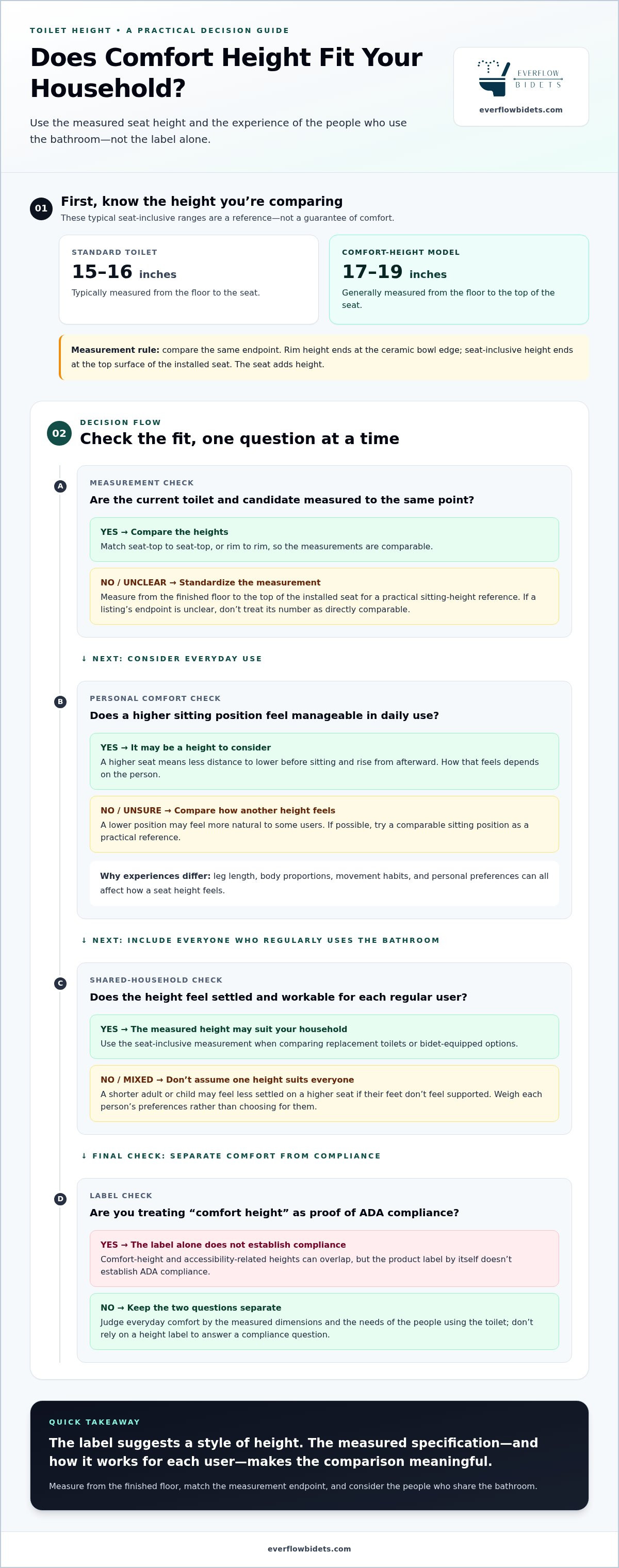
How to Decide Whether Comfort Height Fits Your Bathroom
Work from the people outward: consider who uses the bathroom, compare seat-inclusive heights, assess sitting and standing, and then check the room and toilet fit. This order keeps personal comfort separate from product dimensions and bathroom layout. It also prevents a familiar label from making the decision before you compare the details.
- Identify the users. Consider regular household members, children, guests, and anyone whose mobility needs may change over time. Preferences can differ, so decide whose daily use matters and where the household may need a compromise.
- Compare seat-inclusive measurements. Measure the current toilet from the finished floor to the top of the installed seat. Compare that with candidate specifications measured to the same point.
- Assess movement. Consider whether users can sit down and stand up comfortably and feel steady in the position. A measurement is useful, but it can’t capture everyone’s experience.
- Check the room and fit. Review bowl shape, surrounding clearance, and the toilet’s rough-in, the distance from the wall to the floor drain. These affect fit and placement, not the seat-height measurement.
Which Measurements Should You Compare?
Use one consistent reference for every candidate: floor to the top of the installed seat. Note whether each product’s listed dimension includes the seat; a bowl-rim measurement isn’t directly comparable to a seat-inclusive one. Record your current toilet’s measurement, then compare it with each candidate specification. Keep separate notes for bowl shape, rough-in, and clearance around the fixture. Those checks address compatibility and room fit, not how high the seat feels.
For example, if a specification reports height to the bowl rim, don’t treat that figure as the finished sitting height. Find the seat-inclusive measurement in the product information, or account for the seat only when its dimensions are available. Comparing unlike measurements can make a candidate seem closer to, or farther from, your current setup than it really is.
How Can You Assess Comfort Before Choosing?
Consider each regular user’s experience separately. A chair with a similar seat height can give you an informal sense of how that position feels, but it isn’t a substitute for evaluating the toilet itself. Seat shape, support, and available bathroom space differ. Use the comparison as a starting point, not a guarantee.
If measurements alone don’t settle the choice, give personal preference real weight. A child may need a different approach than an adult, and guests may use the room differently from household members. Discussing those needs can show whether a shared height feels practical or whether another bathroom arrangement makes more sense. The aim isn’t to find a height that suits everyone in theory, but to make an informed choice for the people who use the space.
Once you’ve recorded preferred seat height and room-fit considerations, use them as filters while comparing a comfort height toilet or bidet-equipped replacement. Browse bidet toilet options with your measurements in hand, and compare stated dimensions without assuming the category name guarantees a particular fit.
Choosing a Comfort Height Bidet Toilet Without Guessing
Use the seat height that felt right in your comparison as a reference, not as an assumption about every bidet-equipped toilet. Product listings can describe height differently, so compare the finished floor-to-seat-top measurement wherever it’s available and check whether the seat is included. The goal is to find a configuration that fits the bathroom and works for the people who use it.
As you compare bidet toilet options, consider both the measured sitting height and the type of setup you want. A familiar category name doesn’t replace dimensions or details about what the product includes.
Integrated Bidet Toilet or Separate Bidet Seat?
An integrated bidet toilet combines toilet and bidet functions in one fixture. A separate bidet seat fits a compatible toilet in place of its existing seat. Replacing the seat doesn’t necessarily change the height of the toilet base, though the installed seat can affect the final sitting height. Bidet-toilet combinations offer another combined category; compare each product’s actual configuration rather than relying on its category name alone.
If you’re considering a separate seat, keep the existing toilet’s height and shape in view alongside the seat’s fit. If you’re replacing the toilet, assess the complete fixture and its stated dimensions. Either way, your preferred seat height is a useful comparison point, but it doesn’t confirm that a product will fit the bathroom or suit every user.
What to Check in a Product Listing
Read the dimensions carefully. Look for a measurement from the finished floor to the top of the seat, and note whether the listing defines height to the bowl rim or includes the seat. Then compare the bowl shape and overall dimensions with your bathroom space and existing toilet setup. If the listing uses a different measurement point from your notes, don’t treat the figures as a direct match.
Review the product description for the functions that matter to your household. For an integrated product, compare the stated configuration and features with the way you expect to use the toilet. For a separate seat, prioritize compatibility with the existing toilet as well as the finished sitting height. Keep those checks distinct: height concerns how the toilet feels, while shape, dimensions, and compatibility concern whether the setup fits.
A short comparison list can keep the decision clear:
- Preferred seat-inclusive height, measured consistently
- Whether the listed height includes the seat
- Bowl shape and overall dimensions
- Integrated fixture, combination, or separate seat configuration
- Functions that household members value
Use the list to compare specifications, then choose with the bathroom’s regular users in mind. If you’re still weighing options, take your measurements as you explore bidet products. A careful fit comparison is more useful than relying on the comfort-height label alone.
Make Your Next Bathroom Upgrade a Better Fit
A bathroom upgrade is a chance to choose for the way your household lives now while keeping future needs in view. Before settling on a comfort height toilet, decide which measured seat height feels most promising and use it as your starting point for comparing options. Comfort is personal, so the right choice works for the people who use the bathroom, not simply the one with the most familiar label.
EverFlow Bidets offers bidet toilets, bidet toilet seats, and bidet-toilet combinations through its online store, with secure checkout when you’re ready to purchase. Compare product details with your measurements and priorities. A careful decision can support a more comfortable, considered daily routine.
Compare bidet toilets and find an option that fits your needs.
Frequently Asked Questions
Can a comfort height toilet feel too tall?
Yes, a higher toilet can feel too tall if users feel perched or find the position awkward for their usual routine. Comfort isn’t determined by a label, so consider how household members feel when sitting down, using the toilet, and standing afterward. If possible, try a comparable seat position before choosing. When a medical condition or mobility concern affects toilet use, ask a healthcare professional for guidance specific to the user.
Is a comfort height toilet suitable for children?
It can be, but children may need extra support to use a taller toilet confidently. Consider whether they can manage their bathroom routine independently or would benefit from an appropriately sized, stable step stool. Supervise according to the child’s age and needs. In a shared bathroom, consider the routines of children and adults alike, and whether the chosen setup will remain practical as children grow.
What is a toilet rough-in, and does it determine toilet height?
A rough-in is a measurement used to match a replacement toilet to the drain location. To compare options, consult the installation diagram for the candidate toilet and measure the existing setup from the finished wall to the drain’s center. Don’t estimate from the toilet’s outer edge, since that won’t identify the drain location. Confirming this measurement early can help you avoid considering replacements that won’t align with the existing plumbing.
Can replacing only the toilet seat make a toilet comfort height?
A replacement seat may alter the finished sitting position, but the change depends on the seat and toilet combination. Before choosing a bidet seat, check that it’s designed for the existing toilet’s shape and mounting arrangement, then review its dimensions. A seat that fits the bowl may still feel different from the current one. Compare the complete installed setup and consider whether the change works for the people who use it.
Do comfort height toilets come with round and elongated bowls?
Both bowl shapes may be available, so use the existing toilet as a reference rather than assuming a shape from the height label. Note whether your current bowl is round or elongated, then compare the candidate’s outline and dimensions with the room and nearby fixtures. If you’re considering a bidet seat, bowl shape also helps narrow compatible options. Reviewing these details can prevent a height preference from overshadowing practical fit.
Does toilet height affect the rough-in measurement?
No. A toilet’s height doesn’t change the bathroom’s existing drain location. For a replacement, treat drain alignment as a separate compatibility check: identify the rough-in of the current installation, then compare it with the candidate’s installation information. This matters even if the toilet’s seat height suits your household. Keeping both items on your shortlist helps you evaluate comfort and replacement fit without mistaking one dimension for the other.
Disclaimer
The information provided in the EverFlowBidets blog is for general informational and educational purposes only. While we strive to publish accurate, current, and well-researched content, nothing on this website should be considered medical advice, diagnosis, or treatment. Articles discussing the potential health, hygiene, accessibility, or environmental benefits of bidet use are based on publicly available research, manufacturer information, and other reputable sources. Individual results may vary, and any health-related decisions should be made in consultation with a qualified healthcare professional.