

The most helpful hygiene solution for an aging parent may not be a bathroom remodel. The right choice depends on what feels manageable to them, from a simple hygiene aid to a change in their bathroom routine. Finding hygiene solutions for aging parents can feel delicate: you want to offer support without making personal care feel intrusive or taking away independence.
Mobility, reach, comfort, privacy, and personal preferences all matter. An option that works for one person may not suit another. Start with an open conversation about what has become difficult and what kind of help your parent would welcome.
This guide compares practical approaches, including basic hygiene aids, bathroom adjustments, and bidet seats or toilets. You’ll learn what to consider about everyday use, bathroom fit, and your parent’s wishes before choosing a product or planning an installation. The goal isn’t to prescribe a single solution or promise medical benefits. It’s to help your family weigh options thoughtfully and support comfort, dignity, and as much independence as possible. For medical advice or changes related to a health condition, consult a healthcare professional.
Key Takeaways
- Ask what your parent finds difficult and what kind of support they’re comfortable accepting.
- Compare hygiene solutions for aging parents by daily effort, privacy, bathroom changes, and product requirements.
- Consider a bidet as one possible aid for personal cleansing, not a complete solution to every hygiene or care need.
- Check bathroom fit, controls, and instructions before choosing a product.
- Make changes step by step, then ask your parent whether the new routine feels comfortable and practical.
How to assess hygiene needs while protecting an aging parent’s dignity
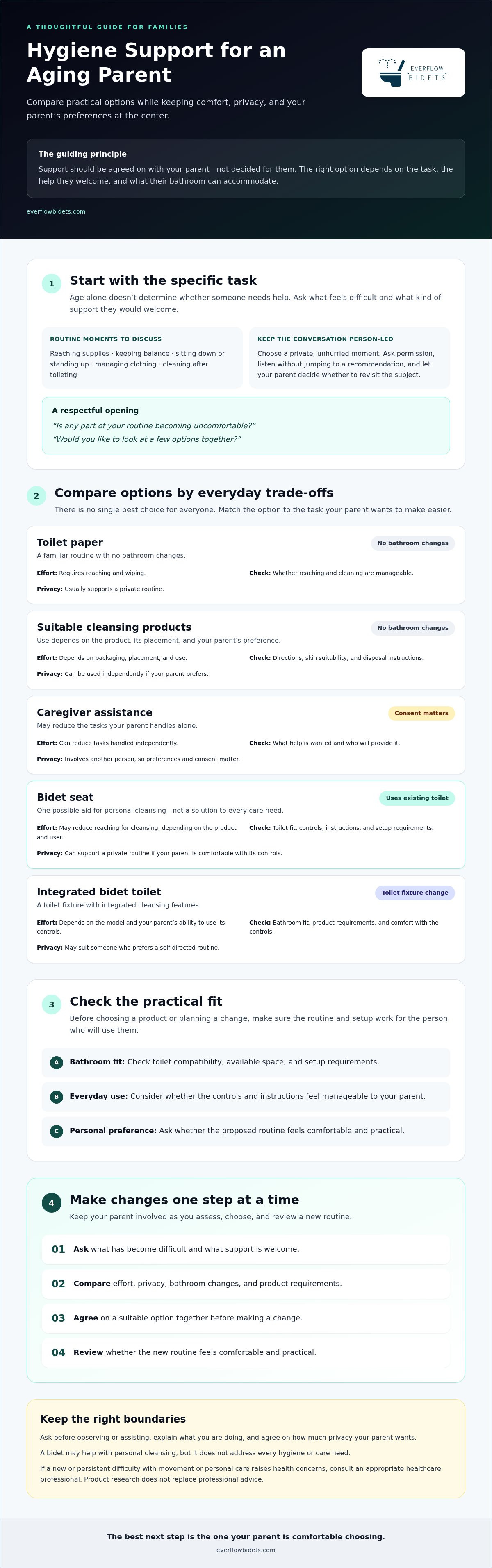
Personal hygiene needs vary from person to person. Age alone doesn’t determine whether someone needs help: one parent may manage every bathroom task independently, while another may welcome a small adjustment or occasional assistance. The aim is to create a routine led by your parent, balancing comfort and privacy with the practical support they want.
Before exploring hygiene solutions for aging parents, ask permission to discuss what feels difficult. If your parent agrees, find out which steps take extra effort without hovering or taking over. A useful framework is Activities of Daily Living (ADLs), which includes everyday personal-care tasks such as bathing and hygiene. Use it as a prompt for conversation, not as a label for your parent.
Which parts of the bathroom routine may need support?
Ask about specific moments rather than making a broad judgment that your parent “needs help.” Reaching supplies, keeping balance, sitting down or standing up, managing clothing, and cleaning after toileting can each present a different challenge. Your parent might prefer equipment, a change in routine, or occasional help, while handling other tasks alone.
Separate personal preferences from changes that may need professional advice. Wanting a different cleansing method is a personal choice. A new or persistent difficulty with movement or personal care may be worth discussing with an appropriate healthcare professional.
How can families raise the subject respectfully?
Choose a private, unhurried moment, not a rushed conversation in the bathroom. Try open questions such as, “Is any part of your routine becoming uncomfortable?” or “Would you like to look at a few options together?” Listen without correcting or immediately recommending a product. Offer choices and let your parent decide what matters most, including whether they want to revisit the conversation later.
Person-led hygiene planning means agreeing on support with your parent, not making bathroom decisions for them.
Permission matters beyond the first conversation. If you’re helping assess the routine, ask before observing or assisting, explain what you’re doing, and agree on how much privacy your parent wants. A specific request can be easier to discuss than a sweeping change: for example, ask whether reaching supplies or cleaning after toileting is the part they’d like to make simpler.
Keep the focus on your parent’s stated needs, not on what family members find most convenient. If a new difficulty persists, worsens, or appears alongside other changes, encourage your parent to speak with a healthcare professional. Product research can help with practical choices, but it doesn’t replace professional advice about health concerns.
Compare hygiene solutions for aging parents by independence and daily effort
The right hygiene option depends on the task your parent wants to make easier, how much help they welcome, and what their bathroom can accommodate. Compare hygiene solutions for aging parents by practical trade-offs, rather than assuming one method is safest or best for everyone.
| Option | User effort | Privacy | Bathroom changes | Points to verify |
|---|---|---|---|---|
| Toilet paper | Requires reaching and wiping | Usually supports a private routine | None | Whether reaching and cleaning are manageable |
| Suitable cleansing products | Depends on packaging, placement, and use | Can be used independently if the parent prefers | None, though convenient storage may help | Product directions, skin suitability, and disposal instructions |
| Caregiver assistance | Can reduce the tasks the parent handles alone | Involves another person, so preferences and consent matter | Usually none | What help is wanted, who will provide it, and whether additional support is needed |
| Bidet seat | May reduce reaching for cleansing, depending on the product and user | Can support a private routine if the parent is comfortable with its controls | Uses the existing toilet, but compatibility and setup need checking | Toilet fit, controls, instructions, and setup requirements |
| Integrated bidet toilet | Depends on the model and the parent’s ability to use its controls | May suit someone who prefers a self-directed routine | Typically involves changing the toilet fixture | Bathroom fit, product requirements, and willingness to learn its operation |
When might a simpler hygiene aid be enough?
If the current routine mostly works, a small change may be more practical than new equipment or caregiver help. A cleansing product, for example, may suit someone who prefers familiar supplies, provided they can reach and use it comfortably. Check the label and disposal directions rather than assuming all wipes are interchangeable. Avoid an aid that adds awkward reaching, affects balance, or creates a disposal challenge. For other personal hygiene tasks where limited reach or dexterity causes difficulty, you can discover Curvy Oral Care for angled tools that help make everyday bathroom routines more manageable.
When could a bidet seat or integrated toilet be worth considering?
A bidet seat or integrated bidet toilet may support a cleansing routine with less hands-on wiping for some users. Neither is a substitute for individualized care, and comfort depends on your parent’s preference, ability to use the controls, and bathroom setup. Check compatibility and product requirements before choosing. To compare options, browse bidet toilet seats.
If a parent needs regular personal-care assistance, equipment may be only one part of the plan. The National Institute on Aging explains in-home support services, including help with personal care. Consider the level of support your parent wants, and seek professional guidance if their needs call for it.
Does a bidet solve every hygiene challenge for an aging parent?
No. A bidet may make one part of a bathroom routine easier for some people, but it doesn’t address every hygiene or care need. It won’t provide transfer support, supervision, or personalized assistance when those are needed. Its value depends on whether your parent likes the idea, can use the controls comfortably, and has a bathroom that can accommodate the chosen product.
A bidet is suitable only when it fits both the individual’s preferences and the bathroom setup. Treat it as one option to assess, not a universal solution or a substitute for individualized care. For example, a parent who finds unfamiliar controls confusing may prefer a simpler routine or another kind of support.
What should families check before choosing a bidet?
Confirm practical details before selecting a model. Check the toilet’s shape and dimensions, the space around it, and whether nearby power access is relevant to the product being considered. Review the manufacturer’s compatibility information for the existing toilet. Don’t assume a seat will fit or that two bidets offer the same controls and functions.
Include the intended user in the review. Look at the controls and instructions together, and consider whether their labels, layout, and operating steps feel manageable. If possible, let your parent explore how the controls work before committing. Verify specifications in the product information, since features vary by model. Product selection is separate from installation planning, so confirm what setup the product requires and who will handle it.
What if the parent needs more than a bidet can provide?
Consider the full bathroom task. A bidet doesn’t help someone move safely between a wheelchair and toilet, manage clothing, or get assistance if they need supervision. If mobility or hygiene concerns are new, persistent, or difficult to manage, discuss them with a qualified healthcare professional. A clinician can help address health-related questions; choosing a bathroom product isn’t medical advice.
For families exploring additional equipment, a Dignity Lifts bidet toilet lift is one product to evaluate, not a recommendation for every user. Check its requirements and suitability for the parent and bathroom, and seek professional guidance if there are concerns about transfers or support needs.
The decision should remain practical and personal. If the controls feel manageable, the setup works, and your parent wants to try it, a bidet may be worth considering for that part of the routine. If any of those conditions don’t fit, another approach may be better.
Plan a bathroom hygiene change with the parent, one step at a time
A thoughtful plan helps families compare hygiene solutions for aging parents without rushing into a purchase or bathroom change. Keep your parent involved at every stage, and treat their comfort and preferences as essential criteria.
- Discuss preferences. Ask what your parent wants to keep the same and what they might like to change. Give them room to decline an option or take time to decide.
- Identify the specific challenge. Pinpoint the task that feels difficult, such as reaching supplies or managing a cleansing routine. A focused problem is easier to match with a practical solution.
- Compare options. Consider whether a simple aid, a routine change, occasional assistance, or a bathroom product best fits the need and your parent’s wishes.
- Check fit and requirements. Before ordering, measure relevant toilet and bathroom dimensions and compare them with the selected product’s documentation. Confirm compatibility and any electrical, plumbing, or setup requirements.
- Review the result together. After the change, ask whether it feels comfortable, understandable, and useful. If not, revisit the choice rather than expecting your parent to adapt to something that doesn’t work for them.
How can families check the bathroom and product fit?
Use the product’s specifications to guide measurements. Check the toilet shape and dimensions, available space, and any stated electrical or plumbing requirements. A photograph or a general product category can’t confirm compatibility. Review installation instructions before purchase, and ask a qualified professional about technical requirements if needed. EverFlow Bidets sells bidet products, not professional installation services, so make separate arrangements for installation if needed.
If you’re considering a bidet, review its controls and instructions with your parent before committing, where feasible. Let them decide whether the steps seem clear and manageable. Verify the exact product details rather than assuming models share the same features or requirements.
How should families review whether the change is working?
Give your parent space to describe the experience honestly. Ask whether the product or new routine feels comfortable, easy to understand, and helpful for the specific task. If the controls, setup, or daily process creates difficulty, adjust the routine or reconsider the option. A product should fit the person, not the other way around.
For a product-focused comparison, look at bidet toilet seat options and check product requirements against your parent’s needs and bathroom measurements before choosing.
Choose a hygiene solution that fits your parent’s preferences and bathroom
The right choice comes down to five practical questions: Which part of the routine is difficult? What does your parent want to change? How much assistance do they prefer? What fits the bathroom? What does the product require? These questions turn a broad search for hygiene solutions for aging parents into a manageable comparison without assuming one product suits every person or home.
Which product category should families explore first?
Let your parent’s priorities guide the starting point. If they want to keep the existing toilet and the main concern is cleansing, a compatible bidet seat may be worth researching. Verify the toilet fit and product requirements before purchasing. If the family is considering a more extensive bathroom update, compare bidet toilet combinations with other options, while checking the bathroom’s requirements and the user’s comfort with the product.
A bidet toilet or combination isn’t automatically a better choice than a seat. The best category is the one that matches your parent’s preferred routine, the amount of change they’re comfortable with, and the available space and setup. If the concern involves mobility, transfers, or personal care beyond cleansing, a bidet product may not address it. Discuss unresolved care questions with an appropriate healthcare professional.
What is a low-pressure next step for families?
Start by comparing product documentation with your parent’s priorities and the bathroom’s measurements. Check compatibility, controls, instructions, and any stated setup requirements. If a product seems promising, review the details together and give your parent time to consider it. For technical questions about electrical, plumbing, or installation requirements, consult the product documentation or a qualified professional.
EverFlow Bidets is an online retailer of bidet products, including bidet toilet seats, bidet toilet combinations, and bidet toilets. Product research can inform a household choice, but it doesn’t replace professional advice about health or care needs. If the option doesn’t suit your parent or the bathroom, keep comparing or choose a simpler approach.
If you’re ready to compare categories, browse bidet toilet seats, combinations, and toilets and review the product requirements before deciding. The next step should be information, not pressure.
Make the next step one your parent chooses
The most suitable hygiene solutions for aging parents begin with your parent’s preferences, not a product category. Identify the bathroom task they want to make easier, compare the level of assistance they welcome, and confirm that any product fits the bathroom and feels manageable to use.
A bidet may support one part of a personal-care routine, but it won’t meet every need. Your parent’s comfort and choice should guide the decision, and health or mobility concerns are best discussed with an appropriate professional.
EverFlow Bidets offers bidet toilet seats, bidet toilet combinations, and bidet toilets to explore online. The retailer doesn’t provide professional installation services, so check product requirements and make separate arrangements for any installation help needed. If a bidet is one option your parent wants to consider, explore bidet options for your home.
Thoughtful conversations and careful comparisons can help your family find an approach that respects your parent’s privacy and supports the independence they want.
Frequently Asked Questions
What are the best hygiene solutions for aging parents who want to remain independent?
The best option is the one your parent prefers and can use comfortably. Start by identifying the task they want to make easier, then compare familiar methods, suitable cleansing products, a bidet seat, or other support. Consider effort, privacy, bathroom fit, and any assistance they want. There’s no single best choice for every family, and a small adjustment to an existing routine may be enough.
Can a bidet help an older adult clean themselves more easily?
A bidet may make cleansing after toileting easier for some older adults, particularly if reaching is difficult and they’re comfortable operating the controls. Its usefulness depends on the person, the product, and the bathroom setup. Review instructions together and check compatibility before choosing. A bidet supports one part of personal hygiene; it doesn’t address every care need or provide medical treatment.
Is a bidet toilet seat difficult for an older adult to use?
It depends on the user and the specific seat. Some people may find the controls intuitive, while others may prefer a familiar routine or need time to learn. Review the controls and instructions with your parent before deciding, where feasible. Consider whether they can see and reach the controls and follow the operating steps comfortably. Check product details directly, since features and controls vary by model.
How do I talk to my parent about needing help with personal hygiene?
Raise the subject privately and calmly, then ask an open question such as, “Is any part of your routine becoming harder?” Avoid starting with a product or assuming they need help. Listen, offer choices, and let your parent set priorities wherever possible. They may want equipment, occasional assistance, a routine change, or no change right now. Respect their answer and revisit the conversation gently if needed.
What should I check before buying a bidet for an aging parent?
Check that the product is compatible with the existing toilet and that the bathroom can accommodate its requirements. Review the toilet’s shape and dimensions, available space, controls, instructions, and any stated electrical or plumbing needs. Confirm specifications in the product documentation rather than assuming models share features. Also ask whether your parent is comfortable using it. Plan installation separately, since EverFlow Bidets doesn’t provide professional installation services.
Can a bidet replace caregiver assistance after using the toilet?
No. A bidet may support cleansing for some users, but it doesn’t replace caregiver assistance if a person needs help with transfers, clothing, supervision, or other parts of toileting. The right level of support depends on the individual’s needs and preferences. For families dealing with cognitive decline or memory loss, reviewing caregiving ebooks for alzheimer's and dementia can provide helpful strategies for managing daily routines. If your parent may need hands-on help or has difficulty managing bathroom tasks, discuss a suitable care plan with an appropriate healthcare professional.
When should a family ask a healthcare professional about changes in bathroom hygiene?
Ask a healthcare professional about new, persistent, worsening, or concerning changes in your parent’s ability to manage personal hygiene or bathroom tasks. A product can’t explain the cause of a change or replace medical advice. Share what you’ve noticed and how it affects the routine, while respecting your parent’s privacy. If you’re unsure whether a change warrants attention, a clinician can advise you based on your parent’s circumstances.
Disclaimer
The information provided in the EverFlowBidets blog is for general informational and educational purposes only. While we strive to publish accurate, current, and well-researched content, nothing on this website should be considered medical advice, diagnosis, or treatment. Articles discussing the potential health, hygiene, accessibility, or environmental benefits of bidet use are based on publicly available research, manufacturer information, and other reputable sources. Individual results may vary, and any health-related decisions should be made in consultation with a qualified healthcare professional.