

The most feature-packed smart toilet isn’t automatically the best upgrade for your bathroom. A model with a long list of functions may add complexity without improving the parts of your daily routine that matter most.
Product listings can make features difficult to compare, and you may be unsure whether your bathroom has the right electrical and plumbing setup. Choosing well doesn’t require mastering every feature. Start with how you’ll use the toilet, the functions you value, and what your space can support.
This guide explains how smart toilets work and how to assess everyday functions such as bidet washing, heated seating, and warm-water control. You’ll compare integrated smart toilets with retrofit bidet seats, which add functions to an existing toilet, and learn what to check for fit, electrical access, plumbing, and setup. By the end, you’ll have practical criteria for choosing an option that suits your bathroom and routine, with realistic expectations about the upgrade.
Key Takeaways
- Learn how controls, electronic functions, and the water supply work together, and why features vary by model.
- Compare an integrated smart toilet with a retrofit bidet seat based on your renovation plans, existing fixture, and priorities.
- Use a fit checklist to assess rough-in, bowl shape, clearance, and dimensions before narrowing your options.
- Build a shortlist that matches your feature preferences with your bathroom’s requirements and your expectations for ongoing care.
What Is a Smart Toilet, and What Makes It Different?
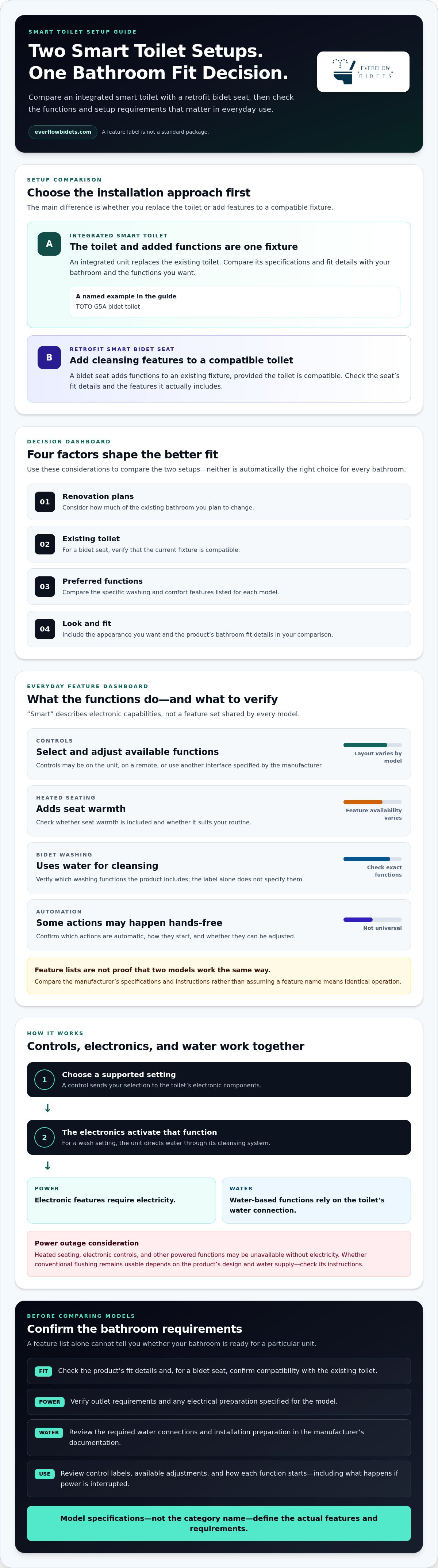
A smart toilet combines a conventional toilet with electronically controlled features. The fixture still handles everyday tasks such as flushing and waste removal, while electronics may operate comfort, washing, or automated functions. “Smart” describes these electronic capabilities, not a standard package of features that every model includes.
Some functions make settings easier to adjust; others may improve comfort or reduce the need to reach for controls. For people planning for changing mobility needs, accessible controls or hands-free functions may also be useful, depending on the model. These features can support comfort and independence, but they don’t replace individualized advice about accessibility needs.
The broader category is sometimes called an Intelligent toilet. To understand a particular model, separate the toilet’s core functions from its optional electronic features, then review the manufacturer’s specifications.
Which functions can make a toilet smart?
Common features serve different preferences. A control panel or remote can operate available functions; a heated seat adds warmth; and a bidet function provides water-based cleansing. Some models may also offer automated actions, such as hands-free flushing. These features aren’t universal, so compare the specifications rather than relying on a product label or category name.
- Controls: Check how users select and adjust each available function.
- Heated seating: Consider whether seat warmth would be useful in your daily routine.
- Bidet washing: Verify which washing functions the product includes.
- Automation: Confirm which actions, if any, occur without manual operation.
Prioritize features you expect to use. A longer feature list doesn’t necessarily mean a better fit.
Smart toilet, bidet toilet, or both?
These terms describe overlapping, but not identical, features. “Smart” refers to electronic functions. “Bidet” refers to water-based cleansing. A toilet may have one, the other, or both, so don’t assume the name tells you exactly what it can do. Compare the specific washing functions and other features listed for each model.
Project scope can also shape your choice. An integrated bidet toilet combines the toilet and added functions in one fixture, while a bidet seat adds cleansing features to a compatible existing toilet. For example, the TOTO G5A bidet toilet is an integrated option. Compare each product’s features and fit details to decide which setup suits your bathroom.
How Smart Toilet Features Work in Everyday Use
Electronic features add convenience and comfort, while basic toilet operation and water supply depend on the fixture’s design. A control sends your selection to the toilet’s electronic components, which activate the functions the model supports. For example, choosing a wash setting may prompt the unit to direct water through its cleansing system. Details vary, so treat feature names as a starting point, not proof that two models work the same way.
Some advanced concepts go beyond ordinary household features. Stanford smart toilet research describes technology designed to analyze waste for health markers. That research is distinct from the comfort and hygiene functions found in consumer products. It shouldn’t be taken as a claim that a retail toilet provides health monitoring.
Controls, settings, and automation
Depending on the product, you may operate functions with a remote, controls mounted on the unit, or another interface described by the manufacturer. The layout matters: clearly labelled buttons and straightforward adjustments can make routine use easier for household members who prefer simple controls over a complicated menu.
Before comparing models, consider who will use the controls and how. Review the manual or product information for button labels, available adjustments, and any steps needed to save or change preferences. Don’t assume every unit includes a remote, uses the same control layout, or offers the same adjustments.
Power, water, and feature dependencies
Electronic functions require power, while water-based functions rely on the toilet’s water connection. Electrical, plumbing, and operating requirements depend on the model and installation context. Use the manufacturer’s documentation to verify outlet requirements, water connections, and any preparation the product calls for. A feature list alone won’t tell you whether your bathroom is ready for a particular unit.
Power outages are another practical consideration. Heated seating, electronic controls, and other powered functions may be unavailable without electricity. Whether the toilet’s conventional flushing operation remains usable depends on the product’s design and water supply, so check its instructions rather than assuming all models behave alike during an outage.
It also helps to distinguish a selectable feature from an automatic one. A control may let you initiate a function, while an automated feature may activate under conditions specified by the manufacturer. Check how each action starts, whether it can be adjusted, and what happens when power is interrupted. These details affect daily use more than a broad label such as “hands-free.”
Once you know which functions and setup requirements matter, explore smart toilet options and compare them with your routine and bathroom requirements.
Smart Toilet vs. Smart Bidet Seat: Which Setup Fits Your Bathroom?
The choice often comes down to how much of the existing bathroom you want to change. An integrated unit replaces the toilet, while a smart seat adds functions to a compatible fixture. Neither setup is automatically the better fit. Renovation plans, toilet measurements, preferred functions, and the look you want all matter.
| Consideration | Integrated smart toilet | Smart bidet seat |
|---|---|---|
| Renovation scope | Replaces the existing toilet, which may suit a broader remodel or planned fixture replacement. | Can upgrade a compatible toilet while leaving the bowl in place. |
| Existing-fixture compatibility | Fit depends on the new unit’s dimensions and your bathroom’s plumbing and installation requirements. | Fit depends on the existing toilet’s shape, dimensions, and mounting area, as well as the seat’s connection requirements. |
| Visual integration | Combines the toilet and electronic functions in one fixture; design varies by product. | Adds a seat to the existing bowl, retaining more of the original fixture’s appearance. |
| Feature priorities | Consider this route if you’re comparing complete fixture designs and the functions offered by each model. | Consider this route if you want selected bidet-seat functions without replacing a compatible toilet. |
When an integrated smart toilet may suit the project
A full bathroom renovation or planned toilet replacement can make an integrated unit a natural option to consider. It lets you select the toilet and its electronic functions together, with a coordinated fixture design, though styling and features vary by model. Review the product’s dimensions and installation requirements alongside your room plan. Browse integrated bidet toilets to compare fixtures by project scope and priorities.
When a smart bidet seat may be the practical route
If your current toilet is in good condition, a compatible seat can add bidet functions without replacing the whole fixture. Check the bowl shape and dimensions, mounting area, and the seat’s specified water and electrical connections. Compare smart bidet toilet seat options with your measurements before narrowing your shortlist.
Use the comparison as a first filter, not a substitute for checking individual product details. Two seats or integrated units can differ in fit, controls, functions, and setup requirements, even when they belong to the same category. Measure your existing toilet and review each product’s documentation before deciding which direction matches your bathroom and planned work.
Smart Toilet Buying Checklist: Fit, Setup, and Ongoing Care
A few measurements and documentation checks can prevent a promising product from being a poor fit. Complete this checklist before comparing individual models. Keep your notes nearby so you can compare your bathroom’s conditions with each product’s specifications, rather than relying on assumptions based on its category or appearance.
Measure the bathroom and existing toilet
Record your measurements first. For a replacement toilet, note the rough-in, commonly measured from the finished wall to the center of the floor drain, and compare it with the terminology and fit diagram in the product documentation. For a retrofit seat, record the bowl’s shape and dimensions, mounting area, and available space around the toilet. Measure the room too, including nearby walls, cabinets, and door clearance.
Plan for setup and regular care
Separate preparation from installation work. Gather measurements, locate nearby electrical and water connections, and review the selected model’s documentation. Electrical and plumbing requirements vary, so don’t assume your current setup meets them. For ongoing care, follow the manufacturer’s cleaning and maintenance instructions. Suitable cleaners and care steps can differ by product.
- Measure the rough-in. Note the distance from the finished wall to the center of the floor drain. Use the product’s fit guidance to determine whether the measurement works for that model.
- Identify the bowl shape. Record whether the existing bowl is round or elongated, if applicable, and compare its shape and dimensions with a retrofit seat’s compatibility information.
- Check fixture and room clearance. Measure the toilet’s overall length and width, the space behind and beside it, and any nearby obstruction that could affect access or movement.
- Review connection requirements. Check the exact electrical outlet, water connection, and operating requirements in the manufacturer’s documentation. Note what is already present and what may need preparation.
- Read setup instructions. Distinguish preparation, such as confirming measurements and locating connections, from plumbing or electrical work involved in installation. Follow the product instructions and arrange qualified professional help for work that requires it.
- Understand care before choosing. Read the manufacturer’s cleaning and maintenance guidance. Consider whether the recommended routine and any model-specific care steps suit your household.
Use the checklist to rule out mismatches before weighing convenience features or design. If a dimension, connection, or care instruction is unclear, rely on the product documentation rather than a general assumption about smart toilet models. Requirements can differ even between products designed for similar projects.
With your measurements and setup notes in hand, compare bidet toilet options against what your bathroom can accommodate.
Choose a Smart Toilet That Matches Your Needs
A useful shortlist starts with the project, not the longest feature list. Decide whether you’re replacing the whole fixture or upgrading an existing toilet. Then compare options against the functions your household will use, what the bathroom can accommodate, and how much ongoing care feels manageable. No single configuration is right for every home.
Match the configuration to your project
For a complete fixture replacement, compare integrated units with your renovation plans, bathroom measurements, and the product’s setup requirements. If your existing toilet is compatible and you want to keep it, consider a bidet seat instead. Match the product to the scope of work rather than assuming one type always offers a better fit.
For a product example, review the current listing for the TOTO G5A bidet toilet as you compare integrated options. Use the listing and manufacturer information to verify the functions and fit details relevant to your project. Don’t infer specifications from the product name alone.
Turn priorities into a shortlist
Separate essential functions from conveniences before comparing models. This keeps your attention on features that matter for everyday use and prevents optional extras from distracting you from fit, setup, and care. Compare the same details across each product’s current manufacturer specifications and listing.
- Project scope: Are you replacing the toilet or keeping a compatible existing fixture?
- Must-have functions: Which features do household members expect to use regularly?
- Optional conveniences: Which additions would be welcome but aren’t necessary?
- Bathroom fit: Do the product dimensions and requirements match your measurements and setup?
- Ongoing care: Do the manufacturer’s cleaning and maintenance instructions suit your household?
Cross off a product if it lacks a must-have function or doesn’t meet a verified fit or setup requirement. Among the remaining options, compare how well each meets your priorities, and treat optional functions as tie-breakers rather than necessities. As you compare, give the same attention to fixture dimensions, controls, setup, and maintenance as you give to the feature list.
This process keeps the decision grounded in your routine and bathroom, rather than a generic “best” label. Once you have a shortlist, browse smart toilet and bidet options and compare the product details with your requirements.
Make Your Next Bathroom Upgrade a Confident Choice
You don’t need to choose every feature at once. Start by deciding what would make a noticeable difference in your daily routine, then weigh that priority against your bathroom plans and the care you’re comfortable maintaining. The right smart toilet upgrade is the one that fits the way you live, not simply the one with the most functions.
As you compare, EverFlow Bidets offers smart toilets, bidet toilet seats, and bidet toilet combinations from brands including TOTO, Horow, Bio Bidet, and Cascade. Use the product details to compare options at your own pace and narrow your shortlist to configurations that suit your home.
Explore smart toilet and bidet options and take the next step toward a bathroom that feels more comfortable and considered every day.
Frequently Asked Questions
Do all smart toilets include a bidet?
No. If water-based cleansing is a priority, treat it as a must-have when comparing models rather than assuming it comes with electronic features. Product names and category labels can be broad, so look for a specific description of the wash function and confirm it in the manufacturer’s specifications. This helps you distinguish models that meet your priorities from those that offer other electronic functions instead.
Does a smart toilet need electricity to work?
Powered features need electricity, but the toilet’s operation during an outage depends on the exact model. Look for outage guidance in its manual and note any steps the manufacturer describes. If continued use during a power interruption is important to your household, make it a comparison point and rely on the product’s operating instructions, not assumptions based on its feature list.
Can I install a smart toilet in an existing bathroom?
Often, yes, but the project may involve more than selecting a fixture. Consider whether you’re remodeling the bathroom or making a targeted upgrade, and plan the work sequence accordingly. For example, coordinate the product decision with any planned changes to the room before removing the existing toilet. If the project requires electrical or plumbing work, include appropriately qualified professionals in your plans.
Are smart toilets difficult to clean?
Not necessarily, but the effort depends on the design and the routine that suits your household. Consider who will handle regular bathroom cleaning and whether the product’s care directions seem manageable. Pay attention to model-specific cleaning steps in the manual. A realistic view of the routine can be as useful as comparing features, especially for a fixture intended for daily use.
Do smart toilets use more water than standard toilets?
Not necessarily. To compare water use, look at the published flush-water use for each specific toilet rather than inferring consumption from electronic features. If water use is a deciding factor, record the manufacturer’s stated figures for the models you’re considering and compare them on the same basis. A model’s smart functions alone don’t establish how much water its flushing system uses.
Can a smart toilet improve bathroom independence for older adults?
It may suit some users’ preferences, but the right choice depends on the individual and their daily routines. Include the person who will use the toilet in the decision where possible, and consider whether the controls and product information are easy for them to understand. A smart toilet should not be treated as a medical treatment or a guaranteed accessibility solution. Consult a healthcare professional for individual medical or accessibility advice.
Disclaimer
The information provided in the EverFlowBidets blog is for general informational and educational purposes only. While we strive to publish accurate, current, and well-researched content, nothing on this website should be considered medical advice, diagnosis, or treatment. Articles discussing the potential health, hygiene, accessibility, or environmental benefits of bidet use are based on publicly available research, manufacturer information, and other reputable sources. Individual results may vary, and any health-related decisions should be made in consultation with a qualified healthcare professional.