
A wipe can clear the toilet bowl and still cause trouble farther down the line. So, are flushable wipes really flushable? The label does not guarantee that a wipe will break apart safely in your home’s plumbing, sewer system, or septic tank. It is understandable to trust packaging that says otherwise, especially when wastewater guidance is more cautious.
The key difference is how wipes and toilet paper behave in water. Toilet paper is designed to disperse after flushing. Wipes are made to hold together during use, so they may stay intact and contribute to clogs even when labeled flushable. The cautious choice for household plumbing and septic systems is to put used wipes in the trash.
This guide explains what “flushable” means, why wipes can cause problems after they leave the bowl, and how to dispose of them responsibly. It also covers water-based cleansing alternatives, including bidet seats that can help reduce reliance on disposable wipes.
Key Takeaways
- Are flushable wipes really flushable? A label does not guarantee they will break down safely in every plumbing or wastewater system.
- Wipes that stay intact can catch in pipes or combine with other debris and potentially contribute to a clog.
- Household drains, municipal sewers, and septic systems can each face different concerns from flushed wipes.
- For disposal, place used wipes in a lined waste bin and wash your hands. A successful flush does not prove a wipe is safe for the system.
- A bidet toilet seat is an optional water-based cleansing method that may reduce reliance on disposable wipes.
Are flushable wipes really flushable? What the label means
The cautious general practice is to put wipes in the trash, not the toilet. So, are flushable wipes really flushable? A wipe may pass through the bowl, but that does not guarantee it will break apart like toilet paper or move safely through every household drain, sewer, or septic system. A successful flush only shows that it left the bowl.
“Flushable” is a product claim, not a promise that a wipe will behave the same way in every plumbing setup. Packaging describes the manufacturer’s claim, but it cannot account for your pipes, other material in the wastewater, or conditions farther along the system.
What does flushable mean on a wipes package?
In practical terms, “flushable” describes a manufacturer’s claim about a wipe’s ability to be flushed under certain conditions. The word alone does not provide a universal, system-specific guarantee, and it should not be treated as equivalent to “breaks down just like toilet paper.” Products can use different materials and behave differently after entering water.
Packaging and local disposal guidance serve different purposes. A label reflects the manufacturer’s claim, while wastewater authorities offer advice for the systems they manage. Check your local wastewater authority’s current guidance, especially if you are unsure what can go into your household plumbing or municipal sewer.
Why are wipes different from toilet paper?
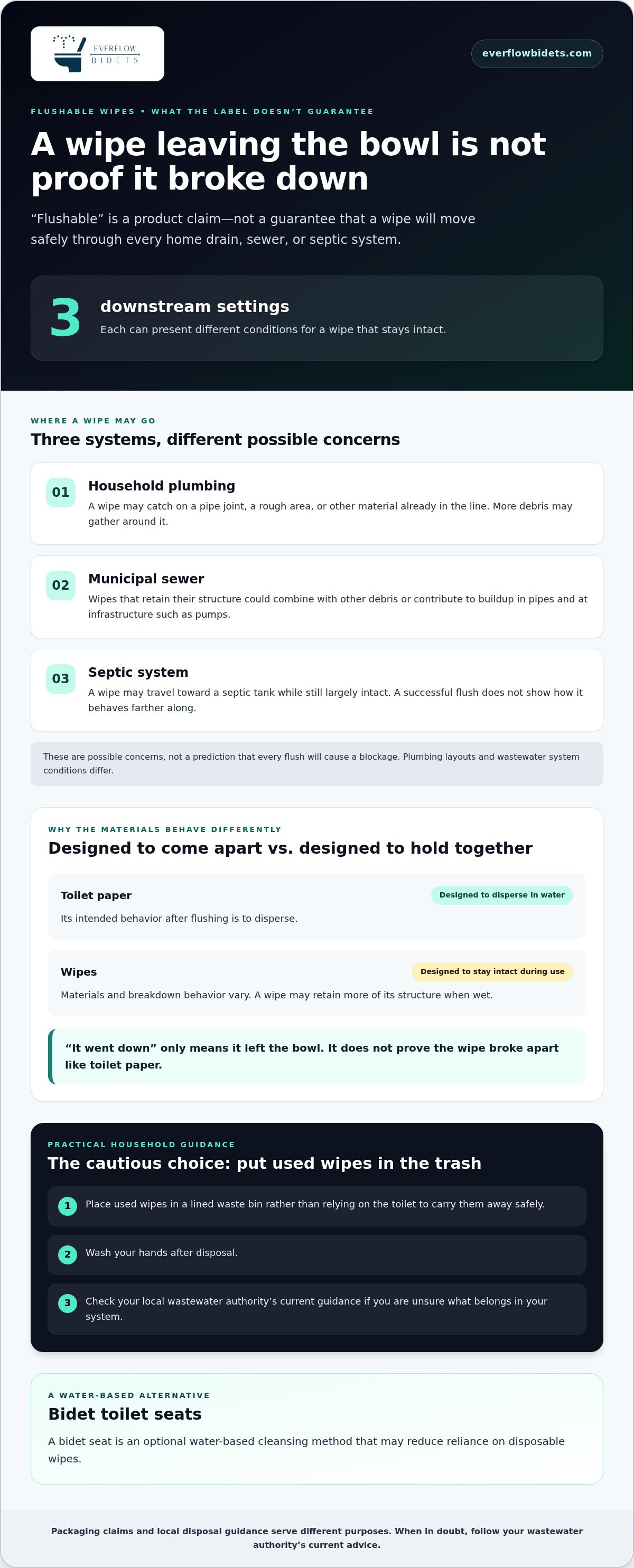
Toilet paper is designed to disperse in water after use. A wipe is designed to stay intact during use, so it can retain more of its structure when wet. Think of the difference between a sheet made to come apart and a damp cloth made to hold together. That distinction helps explain why clearing the bowl is not the same as breaking down in pipes.
Wipes are not all made alike, and their materials and breakdown behavior can vary. Some use plant-based fibers; others may include synthetic materials. For a general overview of the composition and environmental impact of wet wipes, consider how their construction serves their intended use: staying durable when moist. That durability can be useful during cleansing, but it also means a wipe may travel farther through plumbing while still largely intact.
Read “flushable” as a product description, not a guarantee for your home. If the label and local guidance seem to conflict, follow the wastewater authority’s current disposal advice. The cautious household rule is straightforward: put used wipes in the trash rather than relying on the toilet to carry them away safely.
How wipes move through pipes, and why they can cause clogs
After a flush, wastewater carries a wipe through the toilet’s internal passage and into the home’s drainpipes. From there, it may continue into a larger sewer line or, in a private system, toward a septic tank. The route is straightforward, but what happens to the wipe along the way is not guaranteed. It can travel out of sight while still holding its shape.
A wipe that stays intact can catch on plumbing features or collect with other debris, creating a potential starting point for a blockage. That does not mean every wipe will clog every pipe. It explains why one successful flush cannot prove the material dispersed or will pass safely through the rest of the system.
What can happen inside household plumbing?
As a wipe moves through a home’s drain, it may snag on a joint, a rough area inside a pipe, or other material already in the line. If it catches, additional debris may gather around it. A wipe that passes through one section may encounter different conditions farther along, so seeing it disappear from the bowl does not reveal what happened in the pipes.
The condition and layout of plumbing can affect whether material catches or continues moving. These are possible outcomes, not a diagnosis of any particular home. One flush does not guarantee a blockage, and it does not establish that the wipe broke apart safely.
What changes after wipes leave the home?
In a municipal sewer, wastewater travels through connected pipes and may pass through pumps and treatment infrastructure. Wipes that retain their structure could be caught with other debris or contribute to buildup. What happens depends on the system and the material’s condition. Municipal systems have equipment and processes beyond a household drain, but a flush alone cannot tell a homeowner how a wipe will behave there.
Wastewater guidance commonly describes the concern as wipes combining with toilet paper, grease, and other debris, then building up in pipes or at infrastructure such as pumps. This explains a possible mechanism, not a prediction for every sewer system or flush. Local infrastructure and operating conditions differ.
The practical takeaway is to consider what a wipe is designed to do: retain strength during use. That durability can be useful in your hand, but may become a liability as the wipe travels through pipes with other material. For households looking to reduce dependence on disposable wipes, a bidet toilet seat is one optional water-based cleansing alternative.
What flushing wipes can mean for sewer systems, septic tanks, and the environment
The effect of a flushed wipe depends partly on where wastewater goes and what it encounters along the way. A wipe might pass through a home’s pipes without an immediate problem, yet still reach equipment or a system that is not designed to handle material that stays intact. These are potential risks, not a prediction that every flush will cause damage.
Here’s how the main pathways differ:
| System | Possible concern |
|---|---|
| Household plumbing | A wipe may catch in a pipe or collect with other debris, potentially contributing to a blockage. |
| Municipal sewer | Wipes may reach pumps or treatment infrastructure and become part of debris buildup. |
| Private septic system | Wipes that remain intact may accumulate in the tank or move toward other parts of the system. |
Each outcome depends on factors such as the wipe, the plumbing, and the system’s conditions. The table shows where concerns may arise, but cannot predict what will happen in a specific home.
Are flushable wipes safe for septic systems?
Septic-system owners should follow the system’s operating guidance and relevant local recommendations. A wipe that does not disperse readily could remain in the tank or travel into other components, but products and systems vary, so it is not accurate to say every wipe will cause a failure. For questions about tank maintenance or system performance, rely on guidance from septic restoration resources like aero-stream.com or a qualified professional rather than assuming a “septic-safe” label settles the issue.
Do biodegradable wipes break down safely when flushed?
No material description alone proves that a wipe will disperse quickly enough in pipes or wastewater infrastructure. “Biodegradable” concerns whether material can break down under certain conditions; it does not necessarily mean it will separate during its journey through plumbing. Plant-based wording also does not establish that flushing is suitable. For homeowners asking, “are flushable wipes really flushable,” the material claim and the disposal decision are separate questions.
Coverage of wipes discusses environmental concerns alongside plumbing and septic-system issues, reinforcing that disposal involves more than whether a product’s material can eventually break down. Environmental outcomes depend on where a wipe goes and what it is made of. A wipe entering a wastewater system is not automatically evidence that it will reach waterways, just as a biodegradable claim does not establish how it behaves in that system. Do not treat broad material labels as proof of a specific environmental result.
The practical approach is to follow current local wastewater guidance and the instructions for your own septic system. If the guidance is unclear, choose the cautious option and put used wipes in the trash.
What should you do with wipes instead of flushing them?
Choose a disposal routine that does not depend on a wipe breaking apart somewhere out of sight. Are flushable wipes really flushable? A flush that clears the bowl cannot confirm that a wipe is safe for the rest of your plumbing or wastewater system. For everyday use, household trash is the cautious choice. Follow any specific waste-disposal guidance from your community.
A straightforward disposal routine
Keep the steps simple and consistent:
- Use a wipe if you need one.
- Place it in a lined waste bin rather than flushing it. A lidded bin may make this option more manageable in a shared bathroom.
- Wash your hands after disposal.
Check local waste guidance if you are unsure about disposal rules for your household. Recommendations can differ, particularly for items that should not go in recycling or other collection streams. If you use a septic system, follow its operating guidance as well as relevant local recommendations.
Do not use the fact that a wipe disappeared from the bowl as a test. It only tells you the wipe left the bowl, not whether it dispersed or passed safely through the rest of the system. Put it in the bin even if previous flushes appeared uneventful.
What if a wipe has already been flushed?
One flushed wipe does not mean a blockage or damage is certain. Avoid panic, but pay attention to persistent or recurring signs such as slow drainage or a backup. These symptoms can have different causes, so they cannot identify a wipe as the problem on their own. If drainage problems continue or you suspect a blockage, contact a qualified plumbing professional for an assessment rather than trying to diagnose the pipes remotely.
If you share a bathroom, a clearly placed lined bin can make the preferred routine easier for everyone to follow. Explain that wipes belong there even if a package says flushable. This avoids relying on a label or on whether a particular flush seemed successful. Local wastewater guidance can also help settle household questions about what belongs in the toilet.
For a reusable, water-based cleansing option, a bidet toilet seat may help reduce reliance on disposable wipes. It is an alternative to consider, not a requirement or a substitute for every person’s preferences. The disposal rule stays clear either way: put used wipes in the trash, not the toilet.
Can a bidet reduce your reliance on disposable wipes?
A bidet offers water-based cleansing as an option for everyday bathroom hygiene. It may reduce how often you reach for disposable wipes, but it is not a medical treatment or a guaranteed replacement for every wipe, piece of toilet paper, or personal preference. The practical disposal advice remains the same: put used wipes in the trash rather than flushing them.
A bidet toilet seat adds cleansing functionality to a compatible toilet. It gives you another way to approach personal cleansing without relying solely on disposable products. If you are weighing alternatives, bidet toilet seats are one option to explore based on your household’s needs and preferences.
How does a bidet fit into a lower-waste bathroom routine?
Some households may prefer water-based cleansing as part of their usual routine while keeping toilet paper or wipes available for situations where they are still wanted. A bidet does not automatically eliminate the need for either. How it fits depends on personal habits and what feels practical at home.
Do not assume that choosing a bidet will produce a specific environmental benefit or a set amount of paper or wipe reduction. Those outcomes depend on individual use and other factors. A practical reason to consider a bidet is that it provides a reusable option for cleansing with water, giving you an alternative when it suits your routine.
Who might find a bidet seat useful?
The right choice depends on the person and the household. Some people value having another cleansing method available; others may prioritize comfort, routine, or ease of use. A bidet seat may be worth considering if you would like water-based cleansing to be part of your bathroom setup, but it is a personal decision, not a requirement.
For anyone with limited mobility, a different cleansing approach may be appealing as part of a bathroom designed around individual comfort and independence. Needs vary, and a bidet should not be presented as treatment for a health condition. If you have medical questions about personal cleansing or whether a bidet is appropriate for you, consult a healthcare professional.
So, are flushable wipes really flushable? A bidet does not change the cautious answer: dispose of used wipes in the trash, and treat water-based cleansing as an optional alternative. The modern bidet hygiene guidance offers a broader perspective on considering bidets as part of a bathroom routine. If you are considering one for your home, explore EverFlow Bidets and compare bidet seats, bidet toilets, and bidet-toilet combinations to find a format that suits your bathroom.
Choose a cleansing routine that fits your home
The question “are flushable wipes really flushable” points to a broader choice: how do you want everyday cleansing to work in your bathroom? Start with the practical needs of the people who use it, the plumbing or septic setup, and the routines that feel comfortable to maintain. A bidet can be one option to explore, not a requirement or a solution for every situation.
If you are planning a bathroom update, consider cleansing options alongside other decisions about comfort and accessibility. EverFlow Bidets sells bidet toilet seats, bidet toilets, and bidet-toilet combinations. A bidet seat can be a way to add a bidet option to a compatible toilet, while a bidet toilet or combination is another format to consider when planning a larger bathroom change.
There is no need to overhaul your routine all at once. Make a considered choice, keep disposal straightforward, and select an approach that feels right for your household. Explore bidet options for a different cleansing routine and take the next step toward a bathroom that works better for you.
Frequently Asked Questions
Are flushable wipes really safe to flush?
The cautious choice is to keep wipes out of the toilet. In a shared bathroom, make the routine easy to follow by placing a lined waste bin within reach and letting household members or guests know where used wipes go. If you are unsure about local disposal guidance, consult your wastewater authority rather than relying on a package label to settle the question.
What happens if you flush one flushable wipe?
A single flush does not establish that a plumbing problem will occur. If the toilet is draining normally, there is no reason to assume an emergency based on that flush alone. If a backup develops, stop using the affected fixture and seek help from a qualified plumbing professional. Note when the problem began and whether other drains are affected.
Are biodegradable wipes flushable?
Not based on that description alone. Check the package for explicit disposal directions, and treat unclear wording cautiously. “Biodegradable” does not tell you whether the product is intended to be flushed through your particular system. If the instructions say not to flush, follow them. If they are ambiguous, use household trash and consult your local wastewater authority for applicable guidance.
Can flushable wipes clog septic tanks?
They may contribute to septic-system issues, but the outcome depends on the product and system. If your home has a septic system, use its operating or maintenance guidance when deciding what belongs in the toilet. Do not assume a product label covers every system. For questions about a specific product or your system’s operation, consult a qualified septic professional.
Do flushable wipes break down like toilet paper?
No, you should not assume they do. The useful household distinction is how you handle them: follow your local guidance for what belongs in the toilet, and keep wipes separate from toilet paper in your disposal routine. Product materials and behavior can vary, so a wipe’s appearance or the fact that it passed through the bowl is not a reliable way to judge its suitability.
What is the safest way to dispose of used wipes?
Put them in household trash, not another drain. A lined bin near the toilet makes disposal convenient for regular users and visitors. If you are setting up a bathroom for guests, make the bin easy to see and use. Follow your community’s guidance for household waste. Water-based cleansing is another option some people may choose.
Disclaimer
The information provided in the EverFlowBidets blog is for general informational and educational purposes only. While we strive to publish accurate, current, and well-researched content, nothing on this website should be considered medical advice, diagnosis, or treatment. Articles discussing the potential health, hygiene, accessibility, or environmental benefits of bidet use are based on publicly available research, manufacturer information, and other reputable sources. Individual results may vary, and any health-related decisions should be made in consultation with a qualified healthcare professional.