

The best bidet for Crohn's disease may be a simple, adjustable wash rather than the most feature-packed seat. A bidet rinses with a stream of water, offering an alternative or complement to toilet paper when cleaning feels uncomfortable or inconvenient. It can support personal hygiene, but it doesn’t treat Crohn’s disease or replace medical care.
Choosing a bidet is personal. Comfort, water pressure and temperature controls, toilet compatibility, installation, and bathroom privacy all affect the fit. A manual attachment may suit someone who wants a simple setup, while an electric bidet seat can offer built-in settings.
This guide explains how bidets work and compares seats and attachments for everyday use with Crohn’s disease. You’ll learn which features may make washing more comfortable, what installation involves, and how to choose for a shared bathroom, so you can focus on the option that suits your needs and space.
Key Takeaways
- Compare water pressure and temperature controls to find a wash that feels comfortable and is easy to adjust.
- Weigh a manual attachment against a bidet seat by considering the features you want and your toilet’s setup.
- Account for water-line connections, electrical needs, and toilet compatibility when planning installation.
- Consider how a bidet may make cleanup more comfortable, while remembering it doesn’t treat Crohn’s disease or replace medical care.
- For a shared bathroom, prioritize straightforward controls and settings that make the bidet practical for different users.
Adjustable water temperature and cleansing settings
Bidet controls determine water warmth and how the nozzle directs the stream. If Crohn’s-related sensitivity is a concern, compare temperature and pressure separately: a control that changes one may not adjust the other.
Insurance, Medicare, HSA, and FSA eligibility depends on the specific program or plan, not just a bidet’s features. Review the applicable terms for rules on bidet purchases.
Water Temperature Controls
Temperature controls let you select the water warmth on models with this feature. Consumer Reports found that only a couple of the bidet attachments it tested offer warm water. That finding applies to those tested attachments, not every seat or toilet. If warmth matters, compare the controls listed for the specific model.
Temperature and pressure are separate criteria. A warm rinse won’t necessarily feel gentler, so consider both settings. For example, someone who prefers warm water and a low-pressure wash needs controls that allow both choices.
Pressure Settings for Sensitive Skin
Pressure settings change the force of the water stream. If your skin is sensitive, begin at the lowest comfortable setting and adjust gradually. Some attachments combine pressure and direction on one dial: on one model, turning clockwise increased rear-wash pressure, while turning counterclockwise increased front-wash pressure.
Other controls separate stream direction from intensity. Read the model’s labels before use, then make one adjustment at a time. This helps you understand how the nozzle responds without starting with a stronger stream than you want.
Warm-Water Electric Seats
An electric bidet seat may offer warm-water settings, while a manual attachment may have fewer adjustments. Features vary, so don’t assume that every electric seat has adjustable temperature. Check whether the model lists temperature and pressure controls separately.
If you want a warm rinse with a gentle stream, look for controls that let you set each independently. If you mainly want a simple wash, fewer controls may be easier to use. What matters is how the settings fit your routine, not how many functions the seat lists.
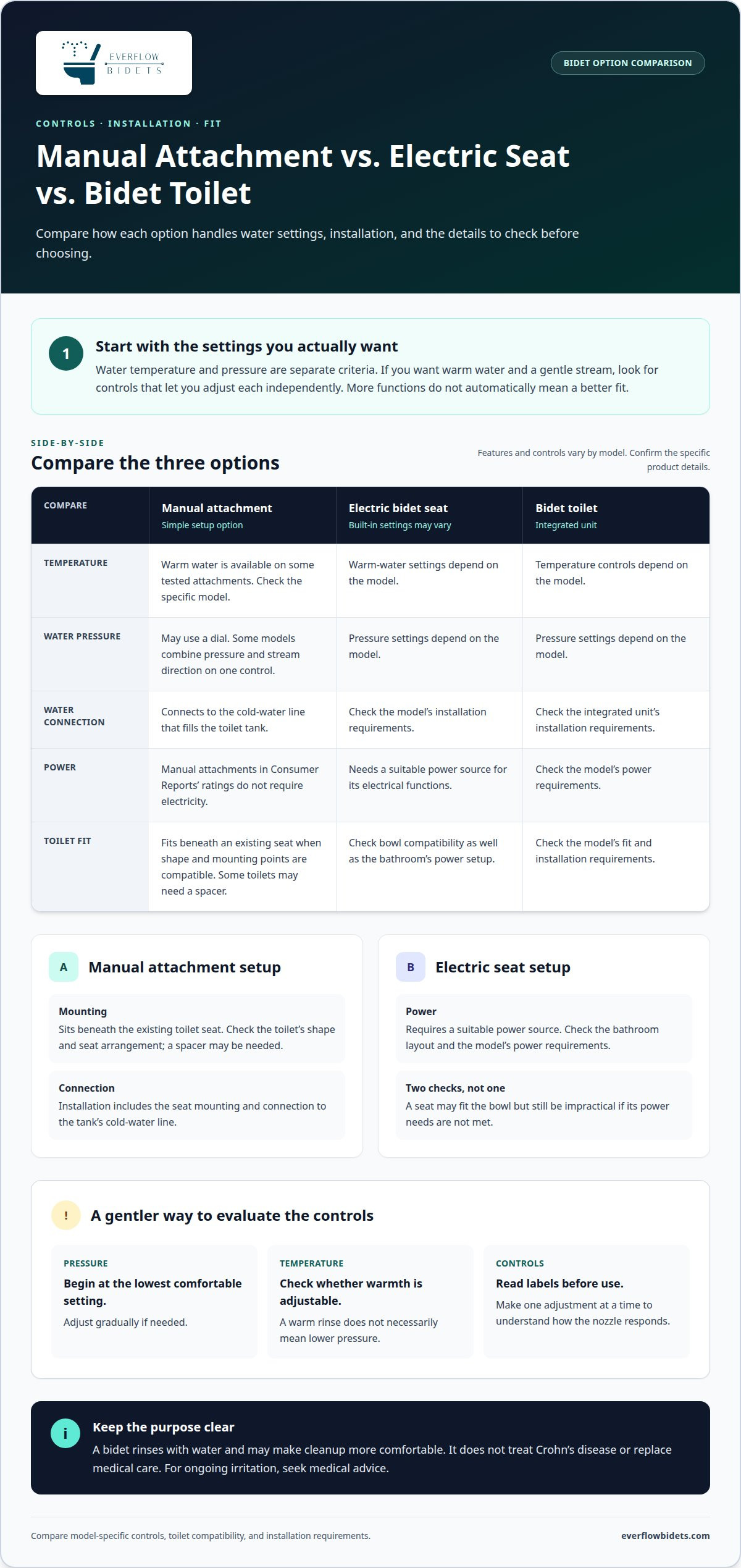
| Option | Temperature | Pressure | Comparison point |
|---|---|---|---|
| Manual attachment | Warm water is available on some tested attachments | May use a dial | Simple controls and available settings |
| Electric bidet seat | Depends on the model | Depends on the model | Whether each setting adjusts separately |
| Bidet toilet | Depends on the model | Depends on the model | Controls included in the integrated unit |
Rank temperature and pressure by your comfort, then compare models for controls that let you manage those settings independently.
Installation and electrical outlet requirements
Installation depends on whether you choose a manual attachment or an electric seat. The main considerations are toilet fit, the water connection, and whether the model needs power.
How do you install and maintain a bidet attachment or seat, and does it fit standard U.S. toilets? An attachment fits beneath an existing toilet seat when its shape and mounting points are compatible; some toilets may need a seat spacer. Follow the model’s installation and cleaning instructions, since fit and care requirements vary.
What bidet hygiene and safety practices help prevent infection or skin irritation? Clean the nozzle and nearby surfaces according to the manufacturer’s instructions, and use the gentlest comfortable wash setting. Regular cleaning supports good hygiene, but a bidet doesn’t replace medical advice for ongoing irritation.
Installing a bidet attachment
A manual bidet attachment connects to the cold-water line that fills the toilet tank. It sits beneath the existing seat, so installation involves both the seat mounting and the water connection. One user reported that an attachment was easy to install under her toilet seat, but toilet designs differ.
Before choosing an attachment, compare its installation requirements with the toilet’s shape and seat arrangement. Some toilets may need a spacer for a suitable fit. Follow the included steps in order, and stop if the parts don’t align or the connection leaks.
Electric seats and outlet needs
Manual attachments in Consumer Reports’ ratings don’t require electricity, making them an option when there’s no outlet near the toilet. Electric bidet seats need a suitable power source for their electrical functions.
The electrical setup is separate from fitting the seat to the toilet. Check the bathroom layout and the model’s power requirements before planning installation. A seat may fit the bowl but still be impractical if its power needs aren’t met.
Cleaning and routine checks
After installation, follow the manufacturer’s cleaning guidance for the seat, attachment, and nozzle. Care instructions and components can differ between an attachment and an electric seat. Regularly inspect the water connection for leaks, and keep controls dry while cleaning nearby surfaces.
In a shared bathroom, keep the controls easy to understand and return them to a comfortable setting after use. If the attachment’s nozzle has a cleaning function, use it as directed; otherwise, follow the model’s manual. Good maintenance starts with the instructions for that product.
To compare bidet toilet seat options, consider both toilet compatibility and the bathroom’s power setup; the right fit must work with both.
Bidet washing for Crohn’s disease
A bidet rinses with water and may make cleanup more comfortable, but it doesn’t treat Crohn’s disease or replace care from a gastroenterologist. If a stream or repeated washing causes discomfort, use gentle pressure and stop if rinsing causes pain.
Helpful Features for Perianal Irritation
For perianal irritation, useful features include adjustable pressure and a nozzle that directs water where needed. These controls let you choose a gentler rinse instead of relying on repeated wiping. Some users may prefer heated water to cool water, but comfort is individual, and warmth doesn’t treat inflammation.
Try one controlled wash, then assess how your skin feels before rinsing again. A bidet can support cleaning and comfort, but it cannot replace treatment prescribed for Crohn’s symptoms.
Bidet Use with Anal Fissures and Hemorrhoids
With an anal fissure or hemorrhoids, the practical priority is avoiding a stream that feels painful or too forceful. Begin at the lowest pressure setting and keep the rinse brief; don’t direct a strong spray at a tender area. A bidet may assist with cleanup, but it doesn’t repair a fissure or treat hemorrhoids.
If water causes pain or irritation, stop using that setting. Discuss persistent or worsening symptoms with a healthcare professional, especially if Crohn’s disease is part of your medical history.
Bidet Use with Fistulas and Crohn’s Symptoms
A fistula or active perianal Crohn’s symptoms call for particular care with comfort and cleaning. Use a gentle rinse rather than a high-pressure stream, and avoid repeated washing if it increases soreness. A bidet may help with external cleanup, but it doesn’t treat a fistula or control Crohn’s activity.
Report blood or mucus in stool to a healthcare professional, as the Crohn’s & Colitis Foundation identifies these as symptoms worth reporting. Follow your clinician’s care plan for fistulas, irritation, or changes in symptoms.
The practical takeaway is to prioritize control over intensity: start gently, use only a comfortable rinse, and stop if discomfort increases. One person living with Crohn’s reported using nearly half as much toilet paper after adopting a bidet, finding it most useful when bowel movements were loose, burning, and frequent. That experience isn’t a treatment outcome or a guarantee for others.
A manual attachment offers straightforward water controls, while a heated electric seat may provide more adjustable features. Either way, a bidet is a hygiene aid, not a substitute for prescribed Crohn’s care. If symptoms change or rinsing causes discomfort, follow up with your healthcare professional.
What bidet features are most helpful for people with Crohn’s disease and perianal irritation?
For Crohn’s-related irritation, prioritize features that make cleansing controllable and reduce unnecessary contact. A self-cleaning nozzle, clear controls, and a drying option may matter more than a long list of settings. Bidets support hygiene and comfort, but they don’t treat Crohn’s disease or replace a clinician’s care plan.
Prioritize gentle, adjustable cleansing
Pressure control lets you choose a softer stream rather than relying on one fixed intensity. Start at the lowest setting and adjust gradually; stop if the rinse increases discomfort. Nozzle-position control can help direct water without shifting your body as much. These features make the wash adaptable, while a basic attachment may offer fewer adjustments.
For front and rear cleansing, consider whether the controls make each wash easy to select. The NEO PLUS range includes dual wash with a front-wash option. A front-wash setting isn’t necessary for everyone, but clear labels can make the function easier to use.
Consider nozzle hygiene and drying
Nozzle care is another practical feature to compare. Consumer Reports says every bidet attachment in its ratings has a self-cleaning nozzle that rinses with water before each use. This describes the attachments in those ratings, not every bidet. Follow the specific model’s cleaning instructions for routine care.
Drying can reduce the need to wipe after rinsing, but cycles differ. The Cascade 3000 bidet seat’s automatic wash-and-dry cycle runs for 1 minute of washing followed by 3 minutes of drying. That may suit someone who values an integrated routine, while a simpler model may require separate drying with a towel or toilet paper.
Choose controls that work during a flare
During a flare, simple controls can make repeated bathroom visits less demanding. Look for easy-to-identify buttons or dials and settings that start a rinse without several steps. For example, a single, clearly marked wash control may be easier to use than a crowded panel with unfamiliar symbols.
Shared bathrooms add another consideration: other household members should be able to understand the controls, too. A seat with straightforward settings may be easier for different users than an attachment with an unintuitive dial. A self-cleaning nozzle can support routine hygiene between uses, alongside regular cleaning of the bidet’s surfaces.
A practical shortlist includes adjustable pressure, simple wash selection, nozzle-cleaning guidance, and a drying method that suits your routine. Weigh these features against the controls you’ll actually use; extra functions add value only if they make cleansing easier to manage. If pain, bleeding, or worsening irritation occurs, contact your healthcare professional rather than relying on a bidet setting to address it.
Do bidet seats offer adjustable water pressure, temperature, nozzle position, and warm-air drying?
Some bidet seats combine these functions, but features vary by model. Compare the available controls and settings on the specific seat. For example, a model may provide heated water and drying, while nozzle-position adjustment varies by product. A feature is useful only if it addresses a preference you have.
Water pressure: Adjustable pressure lets you select the stream’s intensity. Check whether the controls offer distinct levels and are easy to operate. If you prefer a gentle rinse, the ability to choose lower pressure may matter more than a broad range of stronger settings.
Water temperature: Some electric bidet seats offer several temperature levels. For example, the TOTO G5A and G5A Lite have 5 water-temperature levels. That gives users options for adjusting warmth, but the number of settings alone doesn’t determine comfort. Consider whether the controls make your preferred temperature straightforward to select.
Nozzle position: Position adjustment, when available, changes where the spray is directed. This differs from pressure adjustment, which changes the stream’s intensity. Check the model’s feature details and consider whether its adjustments suit your preferences. Don’t assume every bidet seat moves its nozzle in the same way.
Warm-air drying: Drying features vary, too. The TOTO G5A and G5A Lite have warm-air dryers with 5 settings. That gives a user multiple drying options; it doesn’t mean every seat has a dryer or the same controls. If drying matters to your routine, compare whether the model includes it and how it is operated.
Use a short comparison list when reviewing seats. Separate wash settings from drying features, and distinguish adjustable functions from simple on-or-off operation. A clear product description should tell you whether each function is included and adjustable.
- Pressure: Are multiple levels available?
- Temperature: Can you select a comfortable warmth?
- Nozzle: Is position adjustment included?
- Drying: Does the seat include warm-air drying and adjustable settings?
For Crohn’s-related comfort, prioritize the controls that matter to your personal routine rather than choosing by feature count. A seat with clearly described settings can make it easier to understand what you’re selecting. The TOTO S7A bidet seat is one example to compare against your preferences. A bidet supports hygiene, but it doesn’t treat Crohn’s disease or replace medical care.
EverFlow Bidets
EverFlow Bidets offers bidet toilets, bidet toilet seats, and bidet toilet combinations to help you compare options. The right choice depends on which features matter in daily use, whether the toilet and bathroom suit the model, and how you prefer to manage cleansing. A bidet can support personal hygiene and comfort, but it doesn’t treat Crohn’s disease or replace advice from your healthcare professional.
Use the differences between manual controls, adjustable settings, and installation needs to narrow your priorities. EverFlow Bidets’ learning resources and product selection can help you explore the available categories without treating every feature as essential. For help with your bidet questions, contact EverFlow Bidets.
Choose a setup that fits your daily routine
Finding the best bidet for Crohn's disease is less about choosing the most elaborate model and more about finding a setup that feels manageable in your bathroom. Consider which controls you’ll use regularly, how your toilet is configured, and whether a shared space calls for especially simple operation. These priorities can turn a broad comparison into a clear personal choice.
Narrow your options to a bidet seat, toilet, or combination, then compare the product details with your routine. EverFlow Bidets offers these options online, with customer support to help you make an informed choice. A bidet may support comfortable cleansing, but it isn’t a Crohn’s treatment. Keep your healthcare professional involved when symptoms or care needs change.
For guidance as you consider your options, talk through your bidet choices with EverFlow Bidets. A thoughtful selection can make everyday hygiene feel more considered and fit more naturally into your home.
Frequently Asked Questions
What is a bidet?
A bidet is a bathroom hygiene fixture that uses water for cleansing after toilet use. Consider how its controls fit your routine: a dial, side panel, or remote can affect ease of operation. For example, a remote may be easier to reach than controls positioned beside the seat. Compare control placement and clarity alongside the wash functions.
Can a bidet actually help after diarrhea or frequent bowel movements?
A bidet makes water cleansing available after each bathroom visit, which may be useful during a flare. A bidet supports hygiene, but it doesn’t address the cause of diarrhea or replace medical care. Follow your clinician’s advice about managing symptoms.
What should I check before buying with limited mobility?
Prioritize a control layout you can reach and operate without straining, such as an accessible remote or side panel. Check the toilet’s shape and mounting-hole spacing, then consider whether you can transfer onto and off the seat comfortably. Electronic models also need a grounded outlet nearby. These fit and access details help narrow your options before you compare wash features.
Are warm-water bidets safer or more comfortable than cold-water bidets for sensitive skin?
Warm water isn’t automatically safer; temperature is a comfort preference, not a treatment for sensitive skin. A model with adjustable temperature lets you choose a comfortable setting, while a cold-water option may suit someone who prefers it. Stop using either temperature if it causes discomfort. For persistent irritation or a change in symptoms, discuss cleansing choices with your healthcare professional.
What are the best bidet attachments and seats for Crohn’s disease, and how do they compare?
Compare the exact settings rather than relying on a category label. For example, the TOTO S5 seat has 3 water-temperature levels, 5 water-pressure settings, and a warm-air dryer with 3 temperature settings. The Bio Bidet Bliss BB-2000 specifies unlimited warm water. These are distinct feature profiles; decide which functions matter most and confirm that the toilet and bathroom setup suit your choice.
What do gastroenterologists recommend for cleaning and drying the perianal area during a Crohn’s flare?
Ask your gastroenterologist for instructions that fit your symptoms, especially if a flare involves a fistula, fissure, or open skin. Useful questions include whether to use water cleansing, what drying method to follow, and whether to avoid any products. Your clinician can tailor advice to your care plan. A bidet is a hygiene tool, not a substitute for that guidance.
Disclaimer
The information provided in the EverFlowBidets blog is for general informational and educational purposes only. While we strive to publish accurate, current, and well-researched content, nothing on this website should be considered medical advice, diagnosis, or treatment. Articles discussing the potential health, hygiene, accessibility, or environmental benefits of bidet use are based on publicly available research, manufacturer information, and other reputable sources. Individual results may vary, and any health-related decisions should be made in consultation with a qualified healthcare professional.