
The best bidet for renters may be one that doesn’t connect to the apartment’s water supply. If you’re concerned about leaks or plumbing changes, a portable, self-contained option avoids a connection to the toilet’s water line. Before installing a plumbed attachment, review your lease for rules about plumbing fixtures or bathroom alterations.
It makes sense to want a bidet’s comfort and convenience without risking damage or complications when you move. The right choice depends on the setup you’re comfortable with: portable options avoid plumbing connections, while attachments connect to the toilet’s water supply and remain installed.
This guide compares renter-friendly options, explains how attachments are installed and what to consider before choosing one, and covers practical differences such as water pressure, spray adjustment, and warm-water access. You’ll also find a simple decision guide to weigh convenience against installation requirements and choose an option that suits your rental and daily routine.
Key Takeaways
- Review your lease before installing a bidet that connects to the toilet’s water supply; a portable option avoids that plumbing connection.
- Before choosing an attachment, check your toilet’s shape and measurements so the seat can fit properly.
- Test pressure settings over the bowl before use to see whether the spray stays within the rim.
- Compare each option’s installation needs, water source, and adjustability to find the right balance of convenience and renter-friendly setup.
- For a portable model with a pump, charge it before use and dry the reservoir and hose before storing it.
Can I install a bidet in a rental apartment without damaging the plumbing?
Yes, a portable bidet that stays off the apartment’s water supply avoids modifying the toilet’s plumbing. For a plumbed attachment, review lease clauses about bathroom alterations and plumbing fixtures before installation; landlord permission may be needed, especially if warm water matters.
Installations Without Plumbing Modifications
A portable, pump-powered bidet uses its own water reservoir instead of connecting to the toilet’s supply line. That makes it the clearest choice when avoiding plumbing changes is the priority. A plumbed attachment connects to the toilet’s water line, and a handheld sprayer also requires a water connection. Choose a portable option that stays off the apartment’s supply to avoid installation-related leaks.
Installation Ease and Time
Installation effort depends on the design, not simply whether a bidet is called an attachment. A non-electric, ultra-slim dual-nozzle attachment is described as having a 1-minute installation, but that time applies to that specific style. A plumbed unit requires a water-line connection, so it involves more steps than filling a portable reservoir. Follow the product’s instructions and avoid forcing fittings.
Before installing, photograph the bathroom, including the toilet and nearby plumbing. Take another set after removal to document the space’s condition for your security deposit. If you use a pump-powered model, fully charge the pump before first use to help prevent pressure from dropping mid-session. Dry the reservoir and hose before storage to help prevent mildew odors.
Landlord Permission and Lease Rules
Before attaching anything to a toilet’s water line, review lease clauses about plumbing fixtures or bathroom alterations. If warm water is important, get landlord approval before choosing a plumbed bidet. A portable unit avoids that water-line connection, but lease terms still matter for any bathroom changes. Photos taken before and after installation also create a useful record.
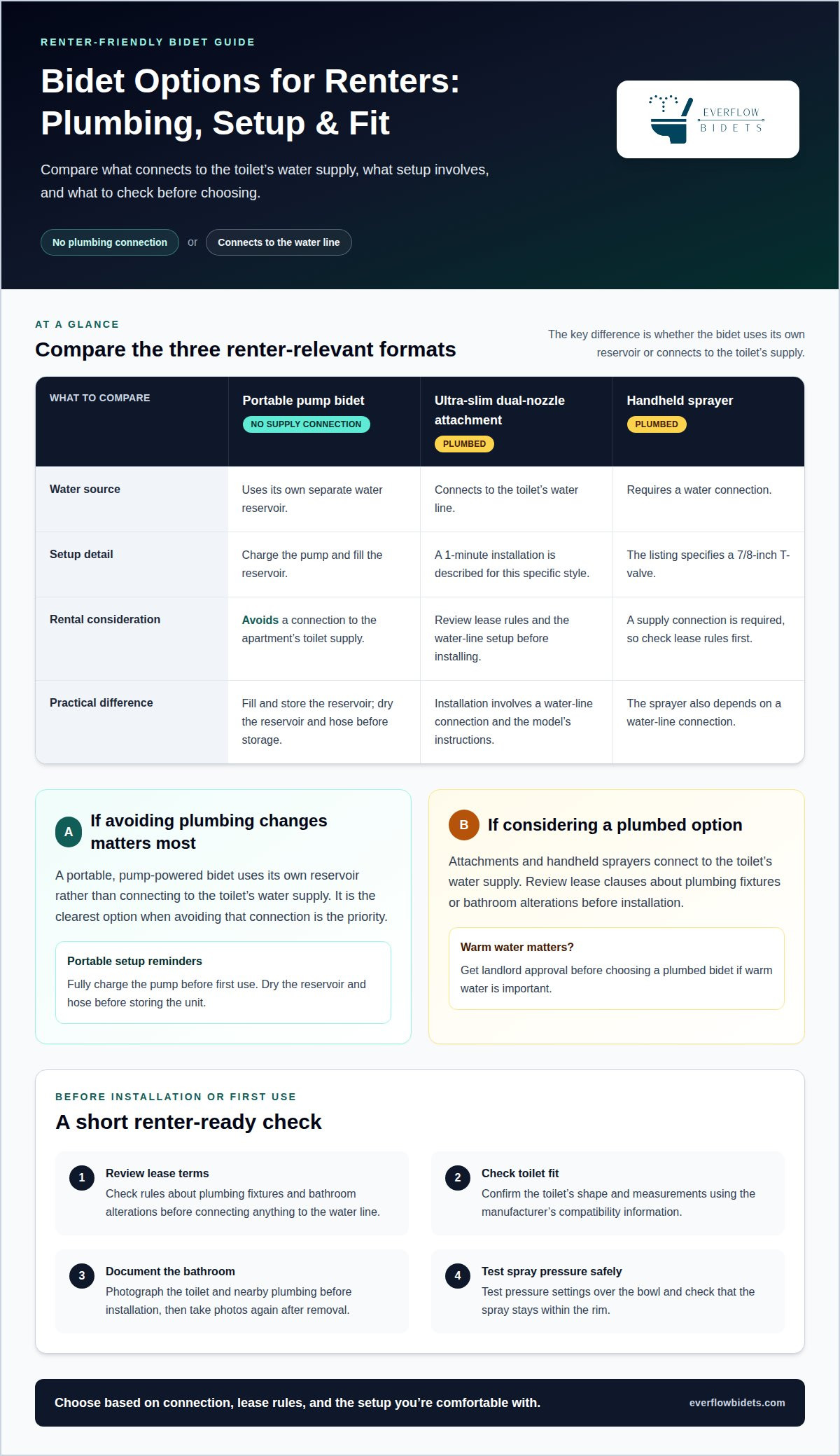
| Option | Water connection | Installation consideration | Rental fit |
|---|---|---|---|
| Portable pump bidet | Separate reservoir | Charge pump; fill reservoir | Avoids toilet supply connection |
| Ultra-slim dual-nozzle attachment | Plumbed | One-minute installation described for this style | Review lease and water-line setup |
| Handheld sprayer | Plumbed | Listing specifies a 7/8-inch T-valve | Requires a supply connection |
To compare seat-style options with other bidet formats, bidet toilet seat options provide a useful reference point, but they don’t remove the need to consider installation and lease terms.
Choose a portable reservoir model if avoiding a plumbing connection matters most. Consider a plumbed attachment only after reviewing the lease and getting approval if warm water is a priority.
Non-electric bidet attachments and installation
Non-electric attachments use water pressure and don’t require an electrical outlet. Controls and connection steps vary by design, so follow the instructions for the exact model rather than assuming every attachment installs the same way.
Non-Electric Bidet Attachments
A non-electric attachment typically uses a mechanical control to direct water through one or more nozzles. Unlike an electric seat, it needs no outlet for powered features, but it also lacks functions that depend on electricity. For renters, the practical difference is how it operates: you turn a manual control rather than use an electronic interface.
Before installation, lay out the attachment, hoses, seals, and included fittings. Read the product instructions and identify which parts connect beneath the seat and which connect to the water line. Keep small components together as you work. This helps prevent confusion over a washer or fitting during installation or later removal.
Toilet-Mounted Bidet Seat Attachments
A toilet-mounted bidet seat replaces the existing seat, while a slim attachment fits beneath it. The style affects how the toilet is assembled and how you reach the controls. Before buying, use the manufacturer’s compatibility information to confirm that the model suits your toilet and mounting arrangement.
For installation, remove and store the original seat and its hardware. Position the attachment or mounting plate as instructed, then secure the seat without overtightening the fasteners. Connect the supplied hose and fittings in the stated order. Use only the tools named in the instructions. Forcing a fastener can damage the fixture or make removal harder.
Non-electric designs may have different controls, such as a dial or lever. Some provide separate nozzle controls, while others use one control to select the spray. Review the control layout before installation to ensure the handle remains accessible once the seat is secured. If the attachment offers multiple spray positions, test the controls over the bowl before regular use.
After connecting the hose, open the shutoff valve gradually and watch the joints as water flows. If a fitting drips, close the valve and follow the product’s troubleshooting instructions before using the attachment. Don’t add sealant or substitute parts unless the manufacturer directs you to. This keeps the installation aligned with the hardware supplied for that model.
When removing the attachment, reverse its installation instructions and keep the original seat hardware available. Place a towel beneath the connection to catch remaining water, then restore the toilet’s original setup. For readers comparing electronic controls with mechanical ones, electric bidet seat designs offer a useful contrast in operation and power needs.
Adjustable water pressure, spray angle, and temperature
Pressure, direction, and temperature affect comfort, but a longer feature list doesn’t automatically mean a better fit. Compare how each control works and whether you’ll use it regularly. For renters, the key question is how a feature improves the experience without making installation more complex or reducing portability.
Adjustable pressure changes the force of the water stream. A gradual control lets you move between gentler and stronger flow, while a simpler control may offer less precise adjustment. Consider who will use the bidet and whether different users prefer different pressure levels. In a shared bathroom, clear, easy-to-operate controls may matter more than a wide range of settings.
Spray angle affects where the water is directed. A movable nozzle or angle control lets you adjust the direction, while a fixed nozzle offers fewer choices. Consider whether you prefer direct control or simpler operation. Nozzle design and control layout matter together: an adjustment is useful only if it’s intuitive to make during use.
Temperature depends on the bidet’s design and water source. A cold-water-only attachment doesn’t heat water; warm water requires a suitable source and may involve additional plumbing. This makes temperature a key deciding factor for renters. If warm water is essential, weigh that preference against the added connection requirements and your rental terms.
- Pressure control: Compare how easily the user can select a preferred flow.
- Spray direction: Decide whether adjustable positioning is useful or a fixed nozzle is simpler.
- Water temperature: Identify whether the design uses cold water or needs a warm-water source.
Controls also affect everyday usability. A dial with distinct positions may be easier to understand than one that requires repeated adjustment. A household with varied preferences may value separate pressure choices, while a single user may prefer a straightforward interface. Treat control descriptions as part of the product comparison, not as a checklist of features to collect.
Portable reservoir models involve a different trade-off: they avoid a fixed water connection, but require filling and handling. Consider whether the reservoir is easy to manage and whether manual direction feels practical. A connected attachment puts controls within reach at the toilet, but its water source determines the temperature options.
Choose the simplest setup that meets your priorities. If adjustable flow matters most, focus on pressure controls. If temperature matters more, first determine which water source the bathroom can support. If portability comes first, consider handling and reservoir use. This keeps your decision grounded in daily routine rather than treating every adjustment as equally important.
Product prices and comparisons
Start price comparisons by distinguishing between bidet formats. A non-electric attachment connects to the toilet’s water supply, while a portable model uses a reservoir. An electric seat adds different features and power requirements. Compare setup, controls, and water source alongside price, since the lowest initial cost may not suit your rental constraints.
On the market, bidet attachments typically range between $42 and $89, with a median of about $63. This range is based on market samples collected November 23, 2026, and is valid through December 23, 2026. It describes attachments generally, not every model or a portable reservoir bidet.
Use this comparison to narrow down the format before weighing individual features:
- Non-electric attachment: Uses the toilet’s water connection and avoids an electrical outlet.
- Portable reservoir bidet: Uses stored water and avoids connecting to the toilet supply.
- Handheld sprayer: Connects to the water supply; the referenced listing specifies a 7/8-inch T-valve.
- Electric bidet seat: Requires an electrical connection for powered features.
The $42-to-$89 market band helps frame attachment prices, but it doesn’t compare every renter-friendly option. A portable unit’s reservoir and pump serve a different setup from a fixed attachment, so don’t treat their prices as interchangeable. Compare the water source and installation requirements first, then weigh controls and portability.
In a rental, installation requirements can matter more to overall value than a small price difference. A lower-priced attachment may still need a water-line connection and landlord approval. A portable design avoids that connection, though it still requires attention to its water reservoir and pump. Choose based on what you can install and use comfortably.
Make feature comparisons specific. Check whether an attachment offers adjustable pressure or spray direction, then consider whether those controls matter in your bathroom. For an electric seat, account for the need for power. Warm water also depends on the unit’s design and water source, not its price alone.
Before comparing products, note the toilet shape, water connection, and any available outlet. Round and elongated bowls need compatible seat shapes, while wall-mounted toilets require careful measuring. These checks help rule out a model that looks attractive on price but won’t fit your toilet or rental setup.
Follow a simple decision order: identify the format that suits your lease, confirm toilet compatibility, then compare controls and price within that category. This prevents a portable bidet, a water-connected attachment, and an electric seat from being judged as if they solve the same problem.
No-plumbing bidets for renters
A self-contained portable bidet can work well in a rental, during travel, or wherever toilet installation isn’t allowed. It stores water in its own reservoir and doesn’t connect to the toilet’s plumbing, so you can use it without altering the bathroom’s water supply.
The main choice is between a manual squeeze-style bottle and a pump-powered reservoir design. A squeeze bottle relies on hand pressure; a pump-powered model uses a pump to deliver water. Both work independently of a toilet connection, but differ in operation and handling. Choose the style that feels easier to hold and use.
Portable designs suit renters who want a bidet without changing fixed bathroom fittings. They also travel with you, unlike a toilet-mounted attachment that stays installed. In a guest bathroom where installation isn’t permitted, you can bring in a self-contained unit and put it away afterward. Its defining benefit is portability, not built-in controls or a fixed seat.
Before choosing a model, consider the routine for each use. You’ll need to fill the reservoir, then position and direct a handheld unit manually. In a small bathroom, consider where you can fill and store it without crowding the sink or counter. For travel, think about whether its shape and storage case will fit in your luggage.
- Manual squeeze bottle: Choose this style if you prefer direct hand control and a simple operating method.
- Pump-powered reservoir: Consider this style if you prefer pump-assisted operation, and follow its charging instructions.
- Toilet-mounted attachment: Set this aside if the rental doesn’t allow installation or water-line connections.
For travel, a portable bidet can be packed and used without relying on the destination bathroom’s toilet connections. In a rental apartment, the same self-contained approach avoids installing a fitting on the toilet. These are practical advantages when the bathroom setup is temporary, shared, or restricted.
Use this decision sequence: first, rule out any option that needs a toilet connection; next, choose between hand-squeezed and pump-powered operation; then consider filling and storage. This keeps your decision grounded in your bathroom and travel routine, rather than in features designed for permanently installed seats.
The best bidet for renters who can’t alter plumbing is a portable, self-contained model. Choose a squeeze bottle for direct manual operation or a pump-powered reservoir for pump-assisted use. Both avoid plumbing modifications; the right fit depends on how you’ll carry, fill, hold, and store it.
EverFlow Bidets
EverFlow Bidets offers bidet toilet seats, bidet toilets, and bidet-toilet combinations for bathroom upgrades. For a rental, the key is whether your chosen setup works with the lease, toilet, and available connections. A portable reservoir bidet may suit a bathroom where installation isn’t allowed; a toilet-mounted option is a different choice when your circumstances allow a fixed connection.
Use the comparisons in this guide to identify your preferred format and the features that matter most, then explore the available product categories with those needs in mind. For help considering your options, contact EverFlow Bidets.
Make a Choice That Fits Your Next Move
The best bidet for renters is one that suits both your current bathroom and your plans beyond it. Before deciding, distinguish what you need every day from features you might value later. This can keep a temporary setup practical while leaving room for a more permanent upgrade if your living situation changes.
Consider how the product will fit into your routine, how easily you can store or move it, and which compromises feel acceptable. A clear list of priorities makes it easier to compare options on your terms rather than choosing by feature count alone.
EverFlow Bidets can help you explore options for your personal hygiene goals and future bathroom plans. Reach out to EverFlow Bidets to discuss your needs, then take the next step with a choice that feels right for your home and routine.
Frequently Asked Questions
How do I remove a bidet when moving out of an apartment?
Follow the model’s removal instructions and keep the original toilet parts for reassembly. Before packing the bidet, check its underside and fittings for retained water, then let them dry. Store the hose, adapter, washers, and fasteners together so no small component gets left behind. Compare the restored toilet with move-in photos, if available, and note any existing wear separately from marks created during removal.
What is the difference between a bidet attachment and a portable bidet?
An attachment stays fixed to the toilet during use, while a portable unit is handled and stored separately. This affects everyday setup: an attachment is ready in place, while a portable model must be brought out and prepared each time. Consider who shares the bathroom, where personal items can be stored, and whether a fixed fixture would disrupt anyone else’s routine.
What are the best renter-friendly bidet attachments and non-electric bidets in 2026?
For renters, the right format depends on how the bathroom will be used. A dual-nozzle attachment may suit someone who wants a mounted option and can use a toilet connection. A portable squeeze or pump-powered design suits a bathroom where fixed equipment isn’t practical. Compare control style, cleaning instructions, storage needs, and whether the setup works for everyone sharing the space.
How much do renter-friendly bidet attachments cost, and what are typical installation costs?
Installation costs depend on the work involved, such as whether the bathroom needs an electrical outlet or only a product connection. For a rental, distinguish the product’s purchase price from any separate electrical or plumbing work before comparing total expenses.
How do you install and remove a bidet attachment without damaging a rental bathroom?
Protect the toilet’s finish by using the supplied hardware and following the product’s installation sequence. Keep the seat and fasteners in a clean, labeled container instead of setting them on a hard floor. During removal, avoid scraping the ceramic with tools or forcing a stuck fitting. If a connection resists movement, pause and consult the product instructions rather than risk damaging the fixture.
Are bidet attachments safe for toilet plumbing, and can they cause leaks or water damage?
A loose connection, damaged fitting, or mismatched parts can cause a leak. Before installing, check the shutoff valve and visible supply line for corrosion or damage, and don’t force a valve that won’t turn smoothly. Check beneath the tank and around the connection again after installation. In a rental, report any existing plumbing issue to the landlord before changing the toilet setup.
What features matter most in a renter-friendly bidet, such as adjustable pressure, self-cleaning nozzles, and easy removal?
Check that the controls are understandable, the unit can be removed as documented, and nozzle maintenance is clearly explained. A self-cleaning function can be useful, but review the manufacturer’s cleaning instructions for the nozzle and surrounding surfaces as well. Consider whether the controls are reachable and legible for everyone using the bathroom. Practical operation and upkeep matter more than collecting features you won’t use.
Disclaimer
The information provided in the EverFlowBidets blog is for general informational and educational purposes only. While we strive to publish accurate, current, and well-researched content, nothing on this website should be considered medical advice, diagnosis, or treatment. Articles discussing the potential health, hygiene, accessibility, or environmental benefits of bidet use are based on publicly available research, manufacturer information, and other reputable sources. Individual results may vary, and any health-related decisions should be made in consultation with a qualified healthcare professional.