

A water rinse cleans, while a dryer offers a hands-free way to finish. A bidet with dryer uses warm air after washing to help dry the skin, providing an alternative to toilet paper. Depending on the model, you may be able to adjust airflow and temperature separately, or choose from fewer controls.
It’s reasonable to wonder whether a dryer is useful or an unnecessary extra. Air drying can add comfort and convenience, but it takes longer than patting dry, and settings vary by seat. Understanding the controls makes it easier to choose a model that fits your routine.
This guide explains why bidet seats include dryers, how adjustable airflow and temperature work, and what to compare without assuming every model is the same. You’ll also learn the basic steps for installing a seat, from checking toilet compatibility to connecting water and power where required. With a clear understanding of the features and installation, you can decide what matters before choosing a seat.
Key Takeaways
- Compare dryer controls before choosing a seat, since adjustment options vary by model.
- Learn how warm-air speed and temperature settings can shape the drying experience.
- Review the basic installation steps, including toilet fit and the connections an electric seat needs.
- Understand how electric bidet seats differ from non-electric attachments and which features each can provide.
- Explore bidet seats, bidet toilets, and bidet toilet combinations to find an option that suits your bathroom and routine.
Can I adjust the warm air dryer speed and temperature separately?
Sometimes. A bidet seat may let you adjust dryer speed and temperature separately, but controls vary by model. Some remotes have distinct buttons; others use presets or combine settings. Review the feature descriptions and operating instructions before choosing to see whether the controls adjust independently.
For safety, review the product’s electrical safety certification, installation instructions, and warranty terms before purchase. Check which parts and failures the warranty covers, and follow the manufacturer’s directions for water and power connections.
Start with your bathroom setup, not the remote. Compare these three practical points before narrowing your options:
- Toilet fit: Match the seat shape and mounting layout to your toilet.
- Controls: Check whether the dryer’s speed and temperature adjust independently.
- Daily comfort: Consider a heated seat and accessible control placement.
For example, if you prefer gentle airflow but warmer air, separate controls let you adjust each without changing the other. A seat with linked settings may require a compromise. The product controls or instructions should explain how its dryer settings work.
Installation also affects your choice. Before removing the existing seat, compare its attachment points with the replacement’s mounting system. Electric models need a suitable power connection, and water connections must follow the supplied instructions. Keep the guide nearby, and don’t force fittings or cables into place.
Heated seating and dryer temperature are separate features. A seat warmer heats the sitting surface; the dryer warms airflow after washing. If both matter to you, look for each feature in the model’s controls and instructions. A warm seat doesn’t necessarily mean the dryer has adjustable heat.
Consider your routine, too. If you prefer simple operation, clearly labeled controls may be more useful than a long settings menu. For a shared bathroom, easy-to-change settings can help users adjust between uses, if the model offers them. Check that the remote is reachable while seated.
Compare the dryer with other seat features, such as wash controls and heated seating. Prioritize functions you’ll use, then confirm the model fits your toilet and installation setup. This helps you choose for comfort and usability, not just a long feature list.
Bidet seats with adjustable warm air dryers
Adjustable warm-air drying can make the finishing step more personal, but controls differ by seat. Compare dryer settings alongside wash and warm-water functions.
Adjustable Warm-Air Dryers
An adjustable dryer lets you change airflow, temperature, or both through the seat’s controls. Some models separate these settings; others offer presets or limited adjustment. If you prefer gentle airflow with warmer air, look for separate speed and temperature controls. Check the feature descriptions and user instructions to see exactly what adjusts.
Consider how the controls work, too. A remote may have separate dryer buttons, while a side panel places them beside the seat. Clear labels make it easier to select a setting without navigating several menus. Straightforward controls can also help when bathroom users have different preferences.
Warm-Air Drying
Warm-air drying directs heated airflow after washing to help dry the skin. Unlike towel or toilet-paper drying, it uses airflow rather than direct contact. The experience depends on temperature, airflow, and positioning, so compare those controls instead of treating every dryer as equivalent.
Think about your routine, too. If you prefer a shorter finishing step, you may still choose to pat dry; another user may prefer to include the dryer in their usual sequence. Read the operating instructions to learn how the dryer starts and stops and how to select its settings.
Warm Water and Other Features
Warm water is for washing; warm air is for drying. They are separate features, even when one remote controls both. Before choosing a seat, confirm that its feature list addresses each preference individually. Warm-water washing alone doesn’t mean the dryer has adjustable heat.
Compare each function with how you’ll use it. Someone who prioritizes a comfortable wash may focus on water controls, while someone who wants to reduce manual drying may prioritize the air dryer. Heated seating is another separate feature, and its presence doesn’t tell you which dryer settings are available.
Make a short comparison list before narrowing your options:
- Dryer: Identify whether speed and temperature adjust separately.
- Wash: Review the warm-water controls as a distinct function.
- Operation: Consider whether the remote or side panel feels intuitive.
- Fit: Match the seat to your toilet before purchase.
Use those priorities to compare bidet toilet seats by their listed controls and functions. This keeps the choice grounded in your daily routine rather than a long feature list.
How do I install a bidet toilet seat?
Most replacement seats attach to the toilet bowl, then connect to water and, for electric models, power. Follow the instructions for your specific seat because mounting hardware and connections vary. Before starting, set out the existing seat’s hardware, the new mounting plate, and the installation guide.
- Check fit: Compare the bowl shape and mounting holes with the replacement seat’s requirements. Confirm there’s enough clearance behind the bowl for the seat and its controls.
- Shut off water: Close the toilet’s shutoff valve, then flush to empty the tank. Place a small container beneath the supply connection to catch residual water.
- Remove the old seat: Undo its mounting bolts and lift it away. Clean the bowl around the mounting holes before positioning new hardware.
- Attach the bidet seat: Secure the mounting plate as directed. Slide or fasten the seat into place, then check that it sits evenly and doesn’t shift.
- Connect the water: Follow the supplied diagram for the included fittings and hose. Tighten connections as instructed, without forcing threads or twisting the hose.
- Restore supply and power: Open the shutoff valve slowly and inspect each connection for leaks. For an electric seat, use the power arrangement specified in its manual.
Test the installation before regular use. With the water supply open, check beneath the tank and around each water fitting. Confirm the seat is firmly mounted, then operate its functions as directed by the manufacturer. If a connection leaks, shut off the water and review the fitting before using the seat.
Electrical requirements vary by model. Some seats need a nearby outlet; non-electric designs don’t use powered functions. Review the installation guide before purchase to understand what your bathroom needs to accommodate. Don’t improvise wiring or water connections; follow the product instructions.
Seat prices vary by configuration and features, so compare functions rather than appearance alone. A model with warm-water washing, a dryer, or heated seating differs from a basic wash-only design. Compare the feature list, toilet fit, controls, and installation requirements together. A higher price doesn’t necessarily mean a seat includes every function you want.
Bidet toilets and replacement seats are different purchases: a complete toilet replaces the existing fixture, while a compatible seat upgrades it. A complete toilet may suit a remodel or fixture replacement; a seat can work with an existing toilet. Decide whether you’re replacing the whole toilet or just the seat before comparing options. That distinction makes installation planning more practical.
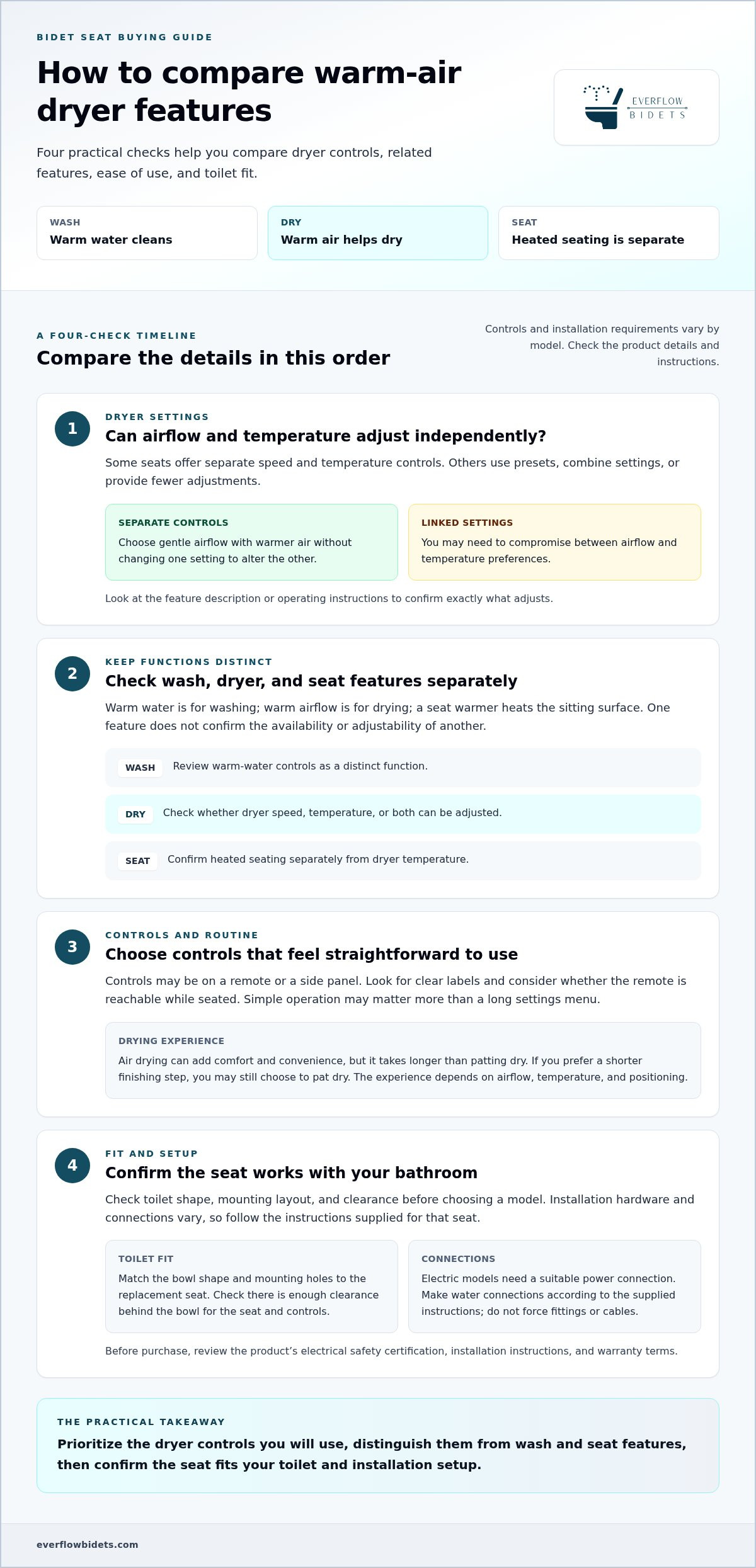
Adjusting dryer speed and temperature
Dryer controls vary by seat, so start with the model’s instructions. Look for separate airflow and temperature controls rather than assuming one button adjusts both. A remote may use labeled buttons, while another control panel may organize settings differently. The manual explains the specific steps for your seat.
Try the dryer after washing. If available, start with gentle airflow and a comfortable temperature, then change one setting at a time. This makes it easier to notice whether the change affects airflow, warmth, or both.
Use the controls deliberately
For independent adjustment, select the airflow setting first, then change the temperature separately. For example, keep airflow gentle while raising the warmth one setting. Pause between changes to assess the difference. If one control changes both sensations, the seat may use linked presets rather than independent adjustments.
Some controls cycle through settings with repeated button presses; others use arrows or a display. Follow the operating guide for the exact method, because button behavior differs between models. Don’t assume another seat’s remote works the same way, even if the labels look similar.
Personal preference is only one factor. Control placement affects how easily you can operate the dryer while seated. A remote should be reachable without twisting, and clear labels can reduce confusion. If several people share a seat, each may need to adjust the settings before use unless the model can save preferences.
- Check the manual: Identify the dryer controls and their order.
- Change one setting: Adjust airflow or warmth, not both together.
- Pause and assess: Notice the effect before making another change.
- Reset if needed: Use the manual’s directions to return to a familiar setting.
Airflow and temperature affect different parts of the experience. A higher airflow setting changes how strongly air moves; a warmer setting changes how it feels. One doesn’t necessarily compensate for the other. If the air feels too forceful but the temperature is comfortable, lower the airflow first.
Dryer performance also depends on the seat’s design and your position. Follow the manufacturer’s instructions for seated use, and avoid leaning or shifting to chase the airflow. If the controls aren’t clear, consult the model’s guide before changing settings. This helps prevent confusion between dryer, wash, and heated-seat controls.
Keep the settings practical. A first-time user might begin with low airflow and moderate warmth, then make small adjustments. In a shared bathroom, check the controls before each use. The best setting is one that feels comfortable and is easy to use consistently.
What is the difference between an electric bidet seat and a non-electric bidet attachment?
An electric bidet seat replaces the existing toilet seat and uses electricity for powered functions. Depending on the model, it may offer warm-water washing, heated seating, or warm-air drying. A non-electric attachment fits beneath a standard seat and uses the toilet’s water supply for washing. Its simpler design doesn’t provide electrically powered functions such as heated air.
That distinction matters if drying is a priority. A non-electric attachment can add a water rinse, but it won’t provide the warm-air dryer found on electric seats. If you want both rinsing and air drying, compare electric seats and check that the feature list specifically includes a dryer. Not every electric model has one.
What an electric seat adds
An electric seat may combine wash settings, a seat warmer, and a dryer in one unit. The exact functions vary by model, so review its controls and instructions to see how each feature operates. If warm-air drying matters to your household, confirm that the selected seat lists a dryer, not just warm-water washing.
Power access is part of the decision. Before buying, review the installation instructions and check whether your bathroom meets the model’s electrical requirements. Then compare the seat’s dimensions and mounting arrangement with your toilet. A feature-rich seat won’t be practical if it doesn’t fit the bowl or available space.
What a non-electric attachment offers
A non-electric attachment focuses on washing without powered comfort features. It connects to the toilet’s water supply and sits between the bowl and existing seat. It may suit someone who wants a rinse without replacing the entire seat. Check the attachment’s fit and installation instructions before choosing it.
Warm-water capability depends on the design. Don’t assume a non-electric attachment heats water or includes a dryer. Compare the listed functions directly, then decide whether a water rinse alone meets your needs. This keeps your choice grounded in what the product actually does.
- Choose electric if a dryer or heated seat matters to your routine.
- Consider an attachment if you want a wash function without powered features.
- Check toilet fit and installation requirements before selecting either type.
- Compare feature lists for warm water, drying, and control options.
Use these differences to narrow your choice, then explore bidet options that match the functions and installation style you prefer.
EverFlow Bidets: Bidet Toilets
EverFlow Bidets offers bidet toilets, bidet toilet seats, and bidet toilet combinations to suit different bathrooms and routines. Choose a bidet toilet seat to upgrade a compatible existing toilet; consider a complete bidet toilet or combination when replacing the fixture or planning a remodel.
Use the features discussed above to narrow your options. Compare dryer controls, warm-water functions, heated seating, toilet fit, and installation requirements. Product details help you distinguish models with the functions you’ll use from those that don’t match your priorities.
Explore bidet toilet options and related seat choices at EverFlow Bidets. For help considering your options, contact EverFlow Bidets or visit everflowbidets.com.
Choose a Setup That Fits Your Daily Routine
Picture how you want your bathroom to work every day. Consider who will use the seat, how simple the controls should be, and whether you’re updating an existing toilet or planning a larger change. These priorities can help you focus on a practical solution for the long term.
A bidet with dryer can support a more comfortable routine, but the right choice depends on your space and preferences. Compare options thoughtfully rather than choosing based on one feature alone. Knowing what matters most makes the decision easier.
If you’d like guidance as you consider your next step, contact EverFlow Bidets for help. You’re ready to choose a setup that supports the way you want to live.
Frequently Asked Questions
Why do bidets have dryers?
Manufacturers include dryers as an optional feature for people who want one seat to handle several parts of their bathroom routine. For example, someone planning an accessible bathroom may value having fewer items to reach or store near the toilet. A dryer isn’t essential to washing, so weigh it against your preferences, routine, and the functions you’ll use consistently.
Will the warm air dryer work with all toilet sizes?
Not every dryer-equipped seat fits every toilet. Before shopping, identify your toilet’s brand and model using purchase paperwork or its product label. Then check the seat manufacturer’s compatibility information for that exact toilet. This is especially helpful in a home with several bathrooms, where toilets may look alike but have different models or configurations.
What is a bidet toilet seat with a warm-air dryer, and how does it work?
It’s a replacement toilet seat with washing and drying functions built into one assembly. The dryer is part of the seat, not a separate bathroom appliance. After washing, you select the drying function through the seat’s controls. This differs from buying a separate toilet and bidet fixture, which take up additional bathroom space.
What are the best bidet seats with dryers in the United States?
There isn’t one best seat for every bathroom, but the TOTO S5 Electronic Bidet Toilet Seat and TOTO S7A Washlet are options to compare. Both list a warm-air dryer with five temperature settings. Compare each model’s full product details, control layout, and features alongside your household’s priorities. A useful shortlist starts with seats that meet your essential needs, not simply the longest feature list.
How much does a bidet with a dryer cost?
There’s no single price for every dryer-equipped bidet. The total depends on whether you’re buying a replacement seat or a complete toilet, as well as the model and its features. Compare the current listing for the exact configuration you’re considering. A standalone seat and a toilet-and-seat combination are different purchases, not equivalent options.
Which features should I look for in a bidet seat with a dryer?
Check the product’s care and control details as well as its comfort functions. For example, the TOTO S5 lists an EWATER+ wand auto-clean feature, an automatic air deodorizer, and a night-light. Consider whether those functions suit your household and whether the controls are easy for intended users to operate. The manufacturer’s instructions can clarify cleaning steps and everyday control use.
How effective are bidet dryers, and how long do they take to dry?
Judge effectiveness by how well the dryer fits your routine, rather than assuming the same result for every user. After installation, try it in ordinary use and decide whether it provides the finish you prefer. Household members may have different expectations, so choose a seat with settings that suit their preferences.
How do I check whether a bidet seat with a dryer fits my toilet?
Start by recording your toilet’s brand and model, then consult the seat maker’s compatibility chart for that fixture. If you can’t identify the model, check the original purchase records or toilet documentation. Keep the product name and model number together when comparing options. This is more reliable than relying on a general description such as “standard toilet.”
Disclaimer
The information provided in the EverFlowBidets blog is for general informational and educational purposes only. While we strive to publish accurate, current, and well-researched content, nothing on this website should be considered medical advice, diagnosis, or treatment. Articles discussing the potential health, hygiene, accessibility, or environmental benefits of bidet use are based on publicly available research, manufacturer information, and other reputable sources. Individual results may vary, and any health-related decisions should be made in consultation with a qualified healthcare professional.